
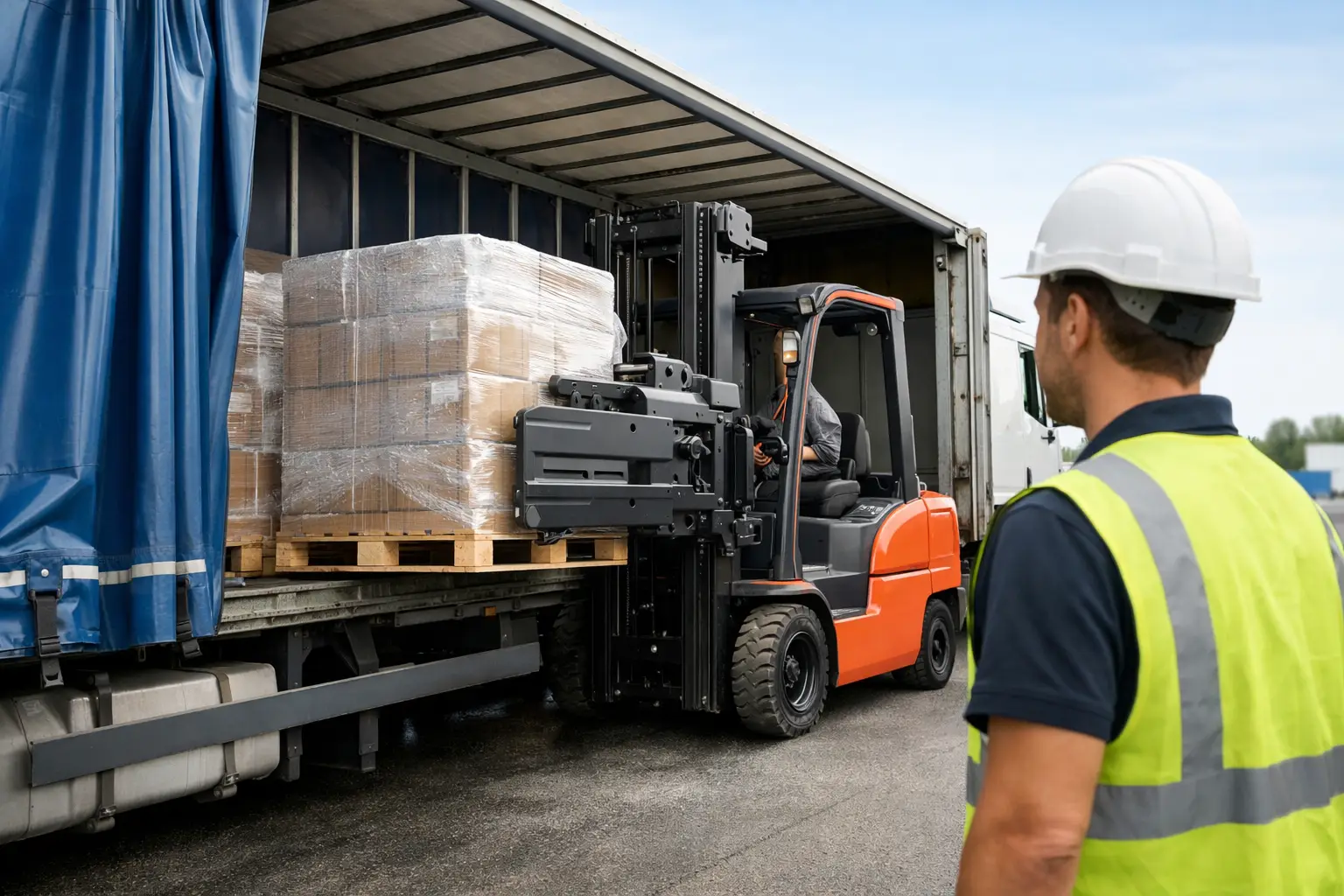
A curtain-sided truck can be loaded quickly from either side, but that access creates a restraint challenge. Curtain side loading is only productive when the load is secured without putting drivers in the line of traffic, forcing them to climb, or adding unnecessary manual handling to every drop.
For fleet operators, this is not a minor workflow issue. Restraint methods affect driver safety, turnaround times, damage risk and the number of labour hours tied up at each loading point. The best approach depends on the freight, the body configuration and the route, but the objective stays the same: keep the load safe and secure while making the job practical for the person doing it.
Curtains provide access, not load restraint
A tautliner is built for flexibility. The curtains pull back to give forklifts clear side access, making it well suited to palletised freight, building products, general distribution and multi-drop work. Once the curtains are closed, the truck presents a tidy, weather-protected load space.
But curtains are not automatically a substitute for a proper load restraint system. Freight can move under braking, cornering, lane changes and rough-road conditions. A load that has shifted against a curtain may be difficult to assess from outside the vehicle and may create a serious hazard when the curtain is opened.
That distinction needs to be clear in loading procedures. The restraint method must be matched to the load, its weight, shape, packaging, restraint points and the vehicle body. Drivers also need a practical way to apply and release restraint without taking shortcuts when the schedule is tight.
Where conventional curtain side loading loses time
Traditional internal straps can do the job, but the process can be labour-intensive. A driver may need to walk around the truck repeatedly, throw straps over or around freight, tension each strap manually, climb to reach higher points, then reverse the process at the delivery site.
Those tasks add up across a shift. On a multi-drop run, even a few extra minutes at every stop can affect delivery windows and driver hours. More importantly, repetitive reaching, pulling and climbing can increase exposure to strains, slips and falls.
The risk is often greater at roadside or constrained sites. There may be limited room beside the vehicle, uneven ground, moving forklifts or passing traffic. A restraint process that requires the driver to work at height or move continuously between both sides of the truck is harder to manage safely in these conditions.
Speed alone is not the answer. Rushing restraint is how straps are missed, loose ends are left unmanaged and freight is accepted as secure when it is not. Productivity comes from reducing unnecessary steps while keeping the restraint process consistent.
Plan the load before the forklift starts
Safe loading starts before the first pallet enters the body. The loader and driver should understand the delivery order, load distribution and restraint plan before freight is placed. This avoids the common problem of discovering that a restraint point is blocked by the final pallet or that freight for the first delivery is trapped behind later consignments.
Weight should be distributed in line with the vehicle’s load limits and axle requirements. Heavy freight needs to be positioned with care, while palletised loads should be placed squarely and stably. Gaps matter too. Uncontrolled spaces can allow freight to build momentum when the vehicle brakes or changes direction.
Consider how each item will behave in transit. A tightly wrapped pallet, a stillage, a long pack of product and an irregular machine part do not all respond to restraint in the same way. Packaging strength, friction, dunnage, blocking and the available anchor points all influence what is required.
This is where a documented loading procedure earns its place. It gives drivers, loaders and supervisors a common method, rather than leaving restraint decisions to be worked out under pressure at the dock.
Ask practical questions at every load
Before closing the curtains, the driver should be able to answer a few straightforward questions. Is the freight restrained for the expected journey? Are the restraints positioned correctly and tensioned as required? Are any straps, tracks, buckles or hooks damaged? Can the load be safely accessed at the first delivery without disturbing freight that must remain secured?
If the answer is unclear, the load is not ready to leave. A quick check at the depot is far easier than dealing with shifted freight at a customer site.
A safer restraint method changes the workflow
The strongest improvement in curtain side loading often comes from changing where and how the driver handles the restraint. Instead of relying on a system that demands repeated climbing, reaching and strap handling at load height, fleets can use a setup designed to keep the task closer to ground level.
A track-mounted restraint arrangement can make straps available where they are needed rather than stored loose inside the body. When paired with purpose-built hardware, the driver can position and retrieve the restraint from the side of the vehicle with fewer movements. That means less time spent walking around the truck and less exposure to the hazards that come with climbing and working beside live loading areas.
For the operation, the gain is consistency. A restraint system that is always fitted to the truck, organised and ready for use is more likely to be used correctly than loose equipment that must be found, untangled and returned after every job.
StrapNGo’s patented Australian-made system is designed around this practical outcome: safer load restraint for tautliners and curtain-sided trucks with minimal labour. The system uses a track, bungee unit and extendable pole with hook to help drivers manage restraints from ground level, reducing the physical effort involved in securing and releasing freight.
That does not remove the need for training or load assessment. No restraint product can make an unsuitable load arrangement safe. It does, however, give operators a more efficient process for the work drivers perform every day.
Choosing a system for your fleet
There is no single restraint method that suits every body and every freight task. A metropolitan pallet fleet may prioritise fast multi-drop access, while a regional operator may need to account for rough roads, long distances and mixed freight. A body builder also needs a system that can be installed cleanly and works with the truck body design.
Start with the vehicles you actually run. Check body type, internal dimensions, restraint track options, common load heights and the clearance needed for curtains, forklifts and other equipment. Then look at the daily handling process. If drivers are regularly climbing, throwing straps or working on the traffic side of the vehicle, those are clear areas for improvement.
Compatibility matters as fleets change. A system that can be fitted through experienced truck body builders and applied across common truck platforms makes standardisation easier. Standardised equipment supports training, inspections and replacement parts, particularly when vehicles operate across multiple depots.
The commercial case should include more than purchase cost. Consider reduced loading time, fewer manual handling movements, easier driver adoption, potential damage prevention and the value of keeping experienced drivers fit for work. In transport, small improvements repeated across every truck and every shift can have a meaningful operational effect.
Keep restraint equipment ready for work
A well-designed system still needs routine inspection. Drivers should check straps for cuts, fraying, contamination and damaged stitching. Tracks, buckles, hooks and associated hardware should be checked for wear, deformation, corrosion or poor operation. Any item that is damaged or suspect should be removed from service and dealt with under the fleet’s maintenance process.
Housekeeping also matters. Loose straps left on the deck can become trip hazards, catch on pallets or be damaged by forklifts. Keeping equipment stowed in its intended position makes the next load faster and helps drivers identify missing or damaged components before departure.
Training should focus on the actual freight and routes the team handles, not a generic demonstration alone. Drivers need to know the approved method, when extra controls are required and when to stop and escalate a problem. Refresher training is particularly useful after a new body fit-out, a change in freight profile or an incident involving load movement.
The most effective curtain side loading process is one drivers can follow at 5 am, at the final drop of a long day and at a crowded customer site. Make safe restraint the easiest part of the job, and productivity has a better chance of following it.