
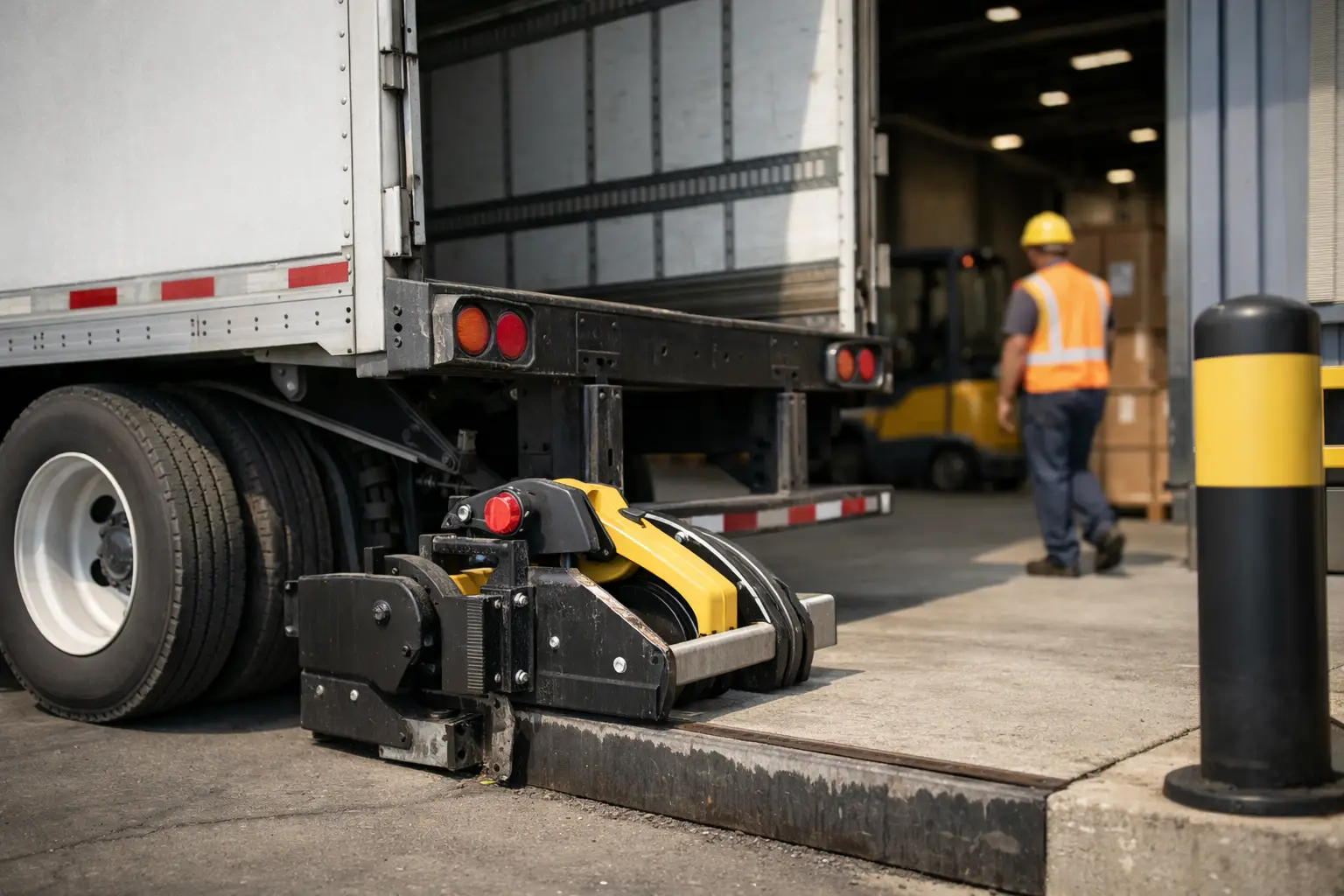
A driver standing on a side rail, wrestling with straps in wind or rain, is not just losing time. They are exposed to a manual handling and fall risk that can be designed out of the job. Effective truck restraints give freight the support it needs while helping drivers secure loads from a safer working position.
For fleet operators, the issue is bigger than selecting a strap that looks strong enough. Restraint equipment affects loading times, driver fatigue, vehicle turnaround, damage risk and the consistency of daily operations. On a busy tautliner or curtain-sided truck, the right system needs to work quickly, fit the body properly and be practical for the people using it shift after shift.
What truck restraints need to achieve
Truck restraints are used to prevent freight moving during transport. Their role is to manage the forces generated by braking, accelerating, cornering and travelling over uneven road surfaces. In a curtain-sided body, the curtain is generally not a load restraint device. The freight still needs to be restrained using suitable equipment and sound loading practice.
A good system should do more than hold a load in place when everything goes right. It should be simple enough that drivers use it correctly under normal time pressure. If a restraint process requires climbing, excessive reaching, repeated bending or difficult strap handling, shortcuts become more likely. That creates risk for the driver, the freight and everyone sharing the road.
The required method will always depend on the load, packaging, weight, load configuration, vehicle body and applicable transport requirements. Palletised cartons, steel products, machinery and mixed freight do not behave the same way in transit. A restraint system must be selected and used as part of a complete load restraint plan, not treated as a one-size-fits-all answer.
Why conventional restraint methods can slow a fleet down
Traditional straps can be effective when they are correctly specified, positioned and tensioned. But conventional methods often place the hard work exactly where drivers face the greatest exposure: beside the vehicle, above shoulder height or on the truck deck.
For a driver completing multiple drops, the issue is cumulative. Climbing up and down, throwing straps over loads and retrieving them at each stop adds physical strain and consumes minutes that quickly become hours across a fleet. Wet straps, tangled webbing and inaccessible anchor points make the task slower again.
There is also a consistency problem. A restraint process that varies from driver to driver is harder for supervisors to manage and harder for new staff to learn. The goal is not to remove driver judgement. It is to give drivers a repeatable method that supports correct use with minimal labour.
The real cost is not only loading time
A few minutes spent securing each load may seem minor in isolation. Across several vehicles, several loads and a full working week, it affects delivery windows, utilisation and overtime. It can also create pressure to rush the final part of a job.
The larger cost comes when a driver is injured, freight is damaged or a vehicle is delayed because a load has shifted. Those events affect customers, schedules and the confidence of drivers who need equipment they can rely on. A safer process is a commercial decision as much as a safety decision.
A better approach for curtain-sided trucks and tautliners
For tautliners and curtain-sided trucks, an integrated restraint system can reduce the need for drivers to climb on the vehicle or manually throw straps across a load. Rather than treating restraint gear as loose equipment that must be found, handled and packed away, the system is installed into the truck body as part of the working environment.
This approach suits operations where speed, repeatability and driver safety matter. A track-mounted arrangement, for example, keeps the restraint equipment in a known position. With the right hardware, the driver can position and secure straps from ground level or a safer location, depending on the load and vehicle configuration.
StrapNGo is designed around this practical need for curtain-sided trucks and tautliners. Its patented Australian-made system combines restraint components with a track, bungee unit and extendable pole with hook to reduce manual handling and improve the speed of securing freight. The focus is straightforward: safe and secure freight restraint with less physical effort.
That does not mean every load can be secured using exactly the same technique. Drivers still need to assess load placement, weight distribution, restraint angles and whether extra measures are needed. The benefit of an integrated system is that it gives them a reliable starting point instead of making every load restraint task a manual workaround.
What to assess before choosing a restraint system
Start with the work your trucks actually do, rather than the equipment catalogue. A metropolitan multi-drop operation has different demands from interstate pallet freight, regional general freight or dedicated industrial loads. Look at the number of restraint actions per day, the types of products carried and the places where drivers currently lose time or take unnecessary risks.
Consider whether the system suits the truck body. Installation quality matters because tracks, mounting points and associated hardware need to work with the body design and intended load restraint arrangement. For new builds, involving the truck body builder early can avoid retrofitting compromises. For existing vehicles, assess the condition of the body and the practical installation options before committing.
Compatibility also matters at fleet level. Operators running a mixed fleet need a solution that can be specified consistently across suitable vehicles, including major brands such as Isuzu, Hino, Fuso, Iveco, UD Trucks, Mercedes-Benz, Scania and Sitrak. Consistency makes training, replacement parts and operational handovers easier to manage.
Finally, assess support after purchase. Restraint equipment is not a fit-and-forget item. It needs inspection, maintenance and replacement when worn or damaged. Australian-based manufacturing, available installers and access to local support can make a meaningful difference when equipment is needed back on the road quickly.
Installation and training are part of the safety outcome
The best hardware will not deliver its full value if it is poorly installed or drivers are left to work out the process themselves. Installation should be completed through capable truck body builders or approved installers who understand the vehicle body and the intended application.
Once fitted, give drivers a clear operating method. Show them how to deploy the equipment, position restraints, use the extendable pole where applicable and stow components securely. Training should also cover what to check before departure: damaged webbing, worn hardware, incorrect placement, loose freight and any change to the load that requires a different restraint approach.
Supervisors should make room for feedback after the first weeks of use. Drivers will quickly identify where a track position could be more practical, where a particular load needs an additional process or where refresher training is required. That feedback is useful operational data, not a complaint about change.
Inspection must be routine
A restraint system is exposed to daily use, vibration, weather and contact with freight. Build quick pre-start checks into normal vehicle preparation. Look for cuts, fraying, deformation, corrosion, damaged hooks, worn fittings and anything that prevents the equipment operating as intended.
Remove suspect equipment from service and follow the manufacturer’s guidance for repair or replacement. A damaged restraint is not made safe by pulling it tighter. Routine inspection protects the driver and helps prevent small defects becoming a load incident.
Safety and productivity should work together
Transport operators should not have to choose between a safer restraint process and a productive one. When the equipment is designed for the job, those outcomes support each other. Less climbing and manual strap handling can reduce exposure to injury, while a faster, more repeatable process helps keep trucks moving.
The right choice depends on the freight task, the truck body and the way the fleet operates. But the test is simple: can drivers secure the load correctly, safely and consistently without adding unnecessary effort to every run? If the answer is no, the restraint process is worth another look before the next truck is loaded.