
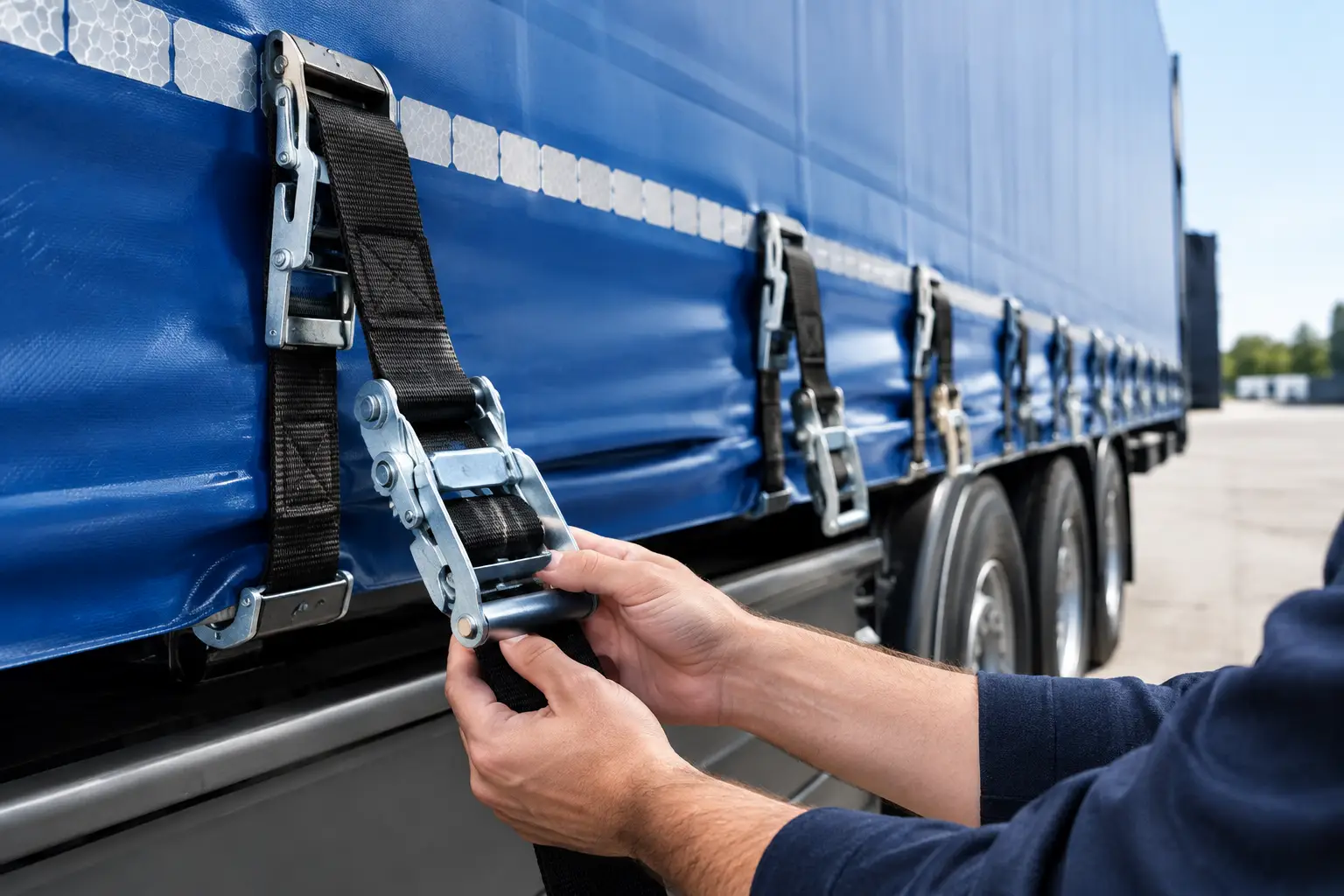
A restraint system can look sound in the yard and still create problems on the road. Knowing how to choose restraint hardware means looking beyond strap rating or purchase price. For tautliners and curtain-sided trucks, the right hardware must suit the freight, truck body, loading process and people using it every day.
The objective is straightforward: keep the load restrained under expected transport forces while reducing avoidable manual handling, roadside exposure and loading delays. Hardware is only one part of the arrangement, but it is the part that connects the restraint method to the vehicle and makes safe, repeatable work possible.
Start with the load, not the hardware catalogue
The first question is not, “Which ratchet or track should we buy?” It is, “What does this truck carry on a normal run?” A fleet moving palletised grocery freight has different restraint needs to one carrying steel, building products, machinery or mixed general freight.
Consider the weight of each load unit, its shape, its centre of gravity, packaging strength and whether it can move, topple or slide. Also consider load gaps. A neatly loaded trailer can still allow freight to shift if there is space for movement during braking, cornering or uneven road conditions.
The NHVR Load Restraint Guide 2025 provides useful guidance for assessing the complete load restraint arrangement. In practical terms, operators need to account for the forces generated during braking, acceleration, cornering and travel over rough surfaces. Hardware must have suitable capacity for its intended role, but capacity alone does not guarantee an effective restraint outcome.
A strap can be strong, for example, yet still be unsuitable if its anchor point is poorly located, the angle is wrong, the load edge is unprotected or the deck surface allows the freight to slide. Selection starts with understanding how the load can move and what method will control that movement.
Check the truck body and fitment points
Curtains are weather protection. They are not generally a substitute for a properly designed load restraint arrangement. Before selecting hardware, inspect the body structure, existing track, anchor locations, deck condition and available clearance around the load.
Hardware must be compatible with the truck body it will be fitted to. That includes the mounting surface, fasteners, track profile, load rating and the way forces are transferred into the body. Installing a quality component into an unsuitable location can compromise both the equipment and the vehicle body.
For new vehicles, involve the truck body builder early. For existing fleets, have the body and proposed mounting arrangement assessed before committing to equipment. This is particularly relevant where a fleet operates different body types, trailer lengths or truck brands. A standardised system can improve training and stock control, but only where it fits each vehicle correctly.
Track systems need more than a good location
Track gives operators flexibility in where restraints are positioned, which can be valuable for variable pallet configurations and mixed loads. However, track selection should consider its rated use, mounting method, end termination and whether the chosen fittings lock securely into the profile.
Placement matters. Track that is too high, too low or poorly positioned relative to the load may create ineffective restraint angles or force drivers to work in awkward positions. The best arrangement is one that provides practical access without encouraging shortcuts.
Match each component to its actual job
Restraint hardware works as a system. Straps, buckles, ratchets, hooks, track fittings, anchor points and load-rated attachment hardware need to work together. Mixing components without checking compatibility can create weak points that are not obvious during a quick pre-start inspection.
When comparing options, confirm the relevant ratings and manufacturer instructions for every component. Do not assume a high-rated strap automatically gives the complete assembly the same capability. The lowest-capacity suitable component, the installation and the restraint method all affect the result.
For tautliners, equipment choice should also account for daily handling. Hardware that is difficult to reach, heavy to operate or prone to tangling may be used inconsistently when drivers are under time pressure. A simpler process can reduce the temptation to climb, stretch across a load or work from an exposed roadside position.
This is where purpose-designed systems can make a commercial difference. A track-based arrangement with compatible hardware and an extendable pole can allow restraints to be positioned from ground level in many applications, reducing the need for drivers to climb onto decks or reach behind freight. The benefit depends on the load, vehicle layout and correct operating procedure, but the manual handling advantage is worth assessing.
Put driver safety beside load security
A restraint method is not a good fleet solution if it secures freight but creates unnecessary risk for the driver. Review the full loading sequence, from opening the curtain through to releasing the final restraint at delivery.
Ask where the driver stands, whether they need to climb, how often they handle straps, and whether they are working beside traffic or in poor weather. Consider the force needed to tension and release equipment, as well as the risk of stored energy when a strap is released.
A practical site assessment should identify whether the process introduces risks such as:
- climbing onto the tray or between load units
- reaching above shoulder height or across unstable freight
- walking repeatedly around the vehicle during loading
- releasing restraints where freight may already be bearing against them.
The answer is not always more hardware. Sometimes it is better hardware placement, a different loading pattern, ground-operated handling equipment or a clearer loading procedure. The right choice reduces risk without making the job slower or more complicated.
Consider productivity over the life of the fleet
Cheap restraint hardware can become expensive if it slows loading, requires frequent replacement or adds minutes to every stop. Across a multi-vehicle fleet, small delays compound quickly. So do injuries, damaged freight, missed delivery windows and vehicles held up for repairs.
Assess the whole-of-life cost. Look at material quality, expected service conditions, availability of replacement parts, cleaning requirements and ease of inspection. Hardware operating in dust, rain, coastal air or high-use distribution work needs to remain reliable under those conditions.
Standardisation can also improve productivity. If drivers move between trucks, consistent track positions, fittings and operating methods reduce familiarisation time. Workshop teams can hold fewer spare parts, and supervisors can train against one clear process. That said, standardisation should not override suitability. A restraint arrangement that works well on a metropolitan pallet run may not be appropriate for irregular regional loads.
Australian-made equipment and local technical support can be practical advantages when parts, fitment advice or installation support are needed quickly. For fleets operating nationally, access to experienced truck body builders and installers is equally valuable.
Make inspection and maintenance part of the decision
Every piece of restraint hardware needs inspection. Choose equipment that makes wear easy to identify rather than easy to overlook. Drivers and workshop staff should be able to spot damaged webbing, bent fittings, corrosion, cracked welds, distorted track, faulty locking mechanisms and worn anchor points before those defects affect a load.
Set clear inspection intervals and quarantine damaged equipment. Do not rely on a quick visual check if hardware has been shock-loaded, involved in an incident or exposed to conditions likely to affect its integrity. Follow the manufacturer’s instructions for use, inspection, repair and replacement.
Good record keeping supports maintenance planning and helps demonstrate that restraint equipment is being managed as part of the fleet’s wider safety system. It also gives procurement teams useful evidence about what lasts in real operating conditions.
How to choose restraint hardware with confidence
A sound purchasing decision brings operations, drivers, workshop staff and the body builder into the same conversation. Drivers understand where the process becomes awkward. Workshop teams understand fitment and maintenance. Operations managers understand the loading patterns, turnaround pressure and cost of downtime.
Before approving a system, trial it on representative vehicles and freight where possible. Watch a normal loading and unloading cycle rather than a staged demonstration. Check whether the hardware can be applied correctly every time, whether drivers can access it safely, and whether the arrangement remains practical when the truck is loaded at less than full capacity.
StrapNGo’s patented Australian-made system is designed for tautliners and curtain-sided trucks where safer, lower-labour load restraint can improve daily operations. Like any restraint solution, it must be correctly installed and used as part of a suitable complete arrangement that meets applicable requirements.
The best hardware is the equipment your team can use correctly on a busy day, in real freight conditions, without creating extra risk. Choose for the load, the body, the driver and the task – then support the decision with correct installation, training and regular inspection.