
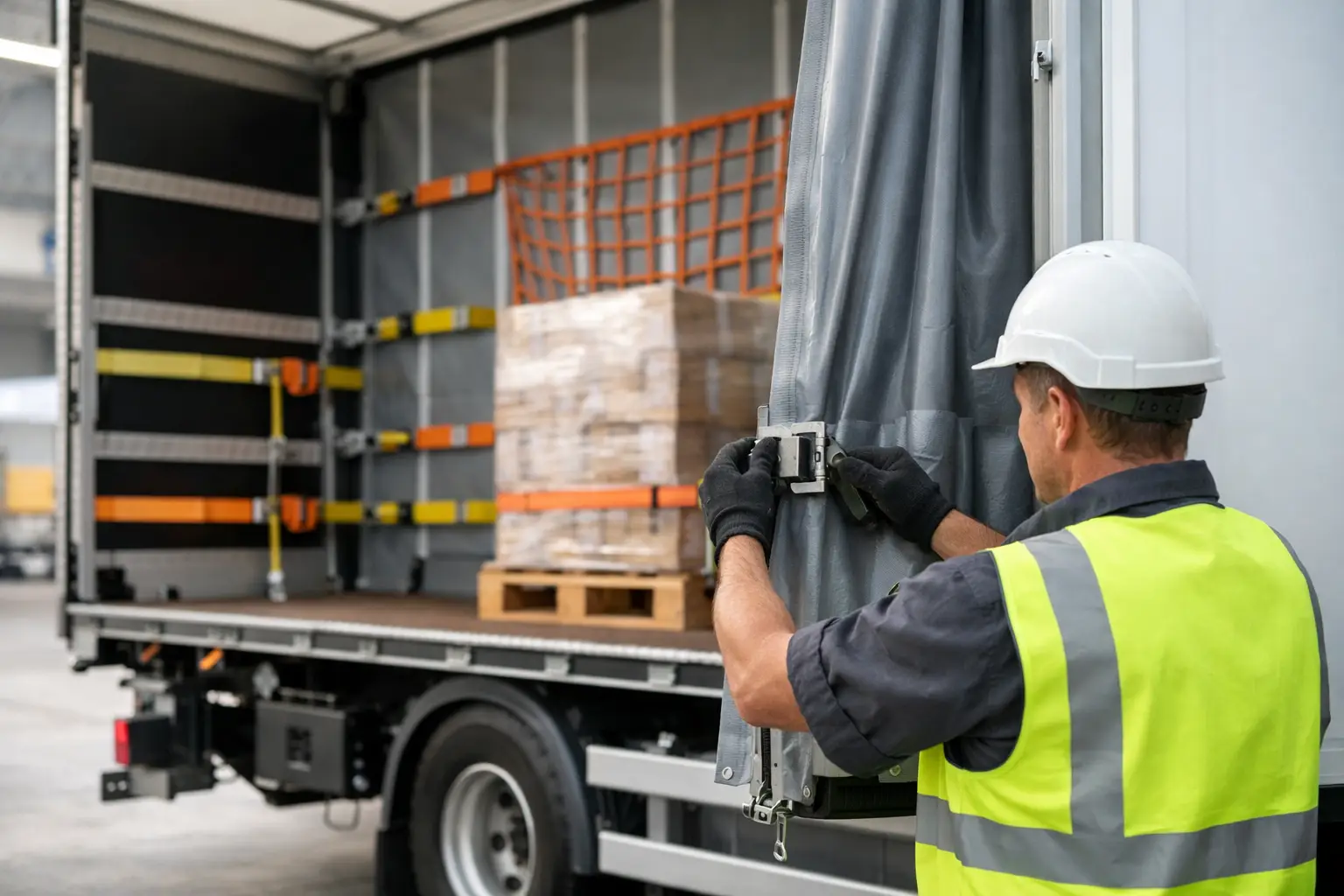
A curtain-sided truck can be a productive freight tool or a daily source of unnecessary risk. The difference often comes down to how the load is restrained and how often drivers need to climb, reach, drag or work beside traffic to do it. The right curtain truck retrofit options can reduce those risks without replacing an otherwise serviceable truck body.
For fleet operators, the decision is not simply about adding hardware. It is about making loading faster, reducing manual handling exposure, supporting compliant load restraint and giving drivers a safer, repeatable process on every run.
Why retrofit a curtain-sided truck?
Many tautliners remain structurally sound long after their original restraint arrangement has stopped meeting operational needs. Traditional internal straps can require drivers to enter the load space, handle heavy equipment above shoulder height and reposition straps repeatedly as freight changes. On a busy distribution schedule, those extra steps cost time and increase fatigue.
A retrofit lets an operator improve the restraint process while retaining the truck body already in service. This is particularly relevant where a fleet has mixed vehicle ages, changing freight profiles or a need to standardise loading procedures across depots.
The best result is not necessarily the system with the most components. It is the arrangement that suits the body, the freight, the loading method and the people using it. A restraint system needs to be accessible when the truck is fully loaded, practical in poor weather and strong enough for the application it is intended to control.
Curtain truck retrofit options to consider
Track and strap restraint systems
A track-based restraint system is a common retrofit choice for curtain-sided trucks and tautliners. Track is installed along the body structure, allowing straps or other restraint fittings to be positioned where the load requires them rather than being fixed to a single point.
This flexibility can be valuable for operators carrying mixed palletised freight, awkward-length items or loads that vary between runs. The key consideration is the track location and its mounting. It must be fitted to suitable structural points by an experienced installer or truck body builder, with the restraint arrangement designed for the vehicle and the work it performs.
Track alone does not remove the manual handling problem. If drivers still need to climb into the body or reach across freight to operate straps, the system may improve load placement without delivering the full safety benefit.
Side-operated load restraint systems
A side-operated system is designed to move key restraint tasks out of the load space and away from overhead reaching. Instead of entering the truck body to throw, retrieve or tension straps, the driver can work from a safer position beside the vehicle.
This is where a purpose-designed system such as StrapNGo can make a practical difference. Its patented Australian-made arrangement uses dedicated track, a bungee unit and an extendable pole with hook to help position and manage restraints with minimal labour. For suitable loads and body configurations, it reduces the need for drivers to climb onto or into the truck during the restraint process.
The value is not just in fewer steps. A consistent side-operated method can help fleets reduce variation between drivers, speed up turnaround and lower exposure to strains caused by repeated reaching, pulling and lifting.
Replacement curtains and curtain hardware
Sometimes the restraint system is not the only issue. Worn curtains, damaged buckles, faulty rollers or poor curtain tension can affect access, weather protection and daily usability. Replacing curtain hardware can be a sensible part of a broader body refurbishment, particularly when the truck is otherwise mechanically reliable.
However, new curtains should not be mistaken for load restraint. Curtains generally provide enclosure and weather protection. Unless they have been specifically engineered, rated and used as part of a compliant restraint arrangement, they are not a substitute for securing the freight inside the body.
When reviewing a curtain replacement, consider how the new curtain design will work with side access, restraint tracks and the driver’s loading sequence. A retrofit should make the job simpler, not create another obstruction at every stop.
Rear-door and body access upgrades
Rear access changes can support safer loading, especially for operations using forklifts, tail lifts or rear loading docks. Options may include improved door hardware, safer latching arrangements, step access or lighting upgrades around the rear of the body.
These additions do not directly restrain freight, but they can improve the overall loading environment. Better visibility and reliable access matter when drivers are securing a load before an early departure or completing a delivery after dark.
They are most effective when planned with the restraint system. For example, a driver should not need to choose between opening a curtain in an unsafe location and working around a poorly positioned rear restraint point.
Start with the freight task, not the product
Before choosing a retrofit, assess what the truck carries most often. Palletised general freight, building products, retail stock, machinery and irregular loads all create different restraint demands. The number of drops also matters. A truck loaded once at the depot and unloaded at a single site has different requirements from a multi-drop vehicle where restraints are adjusted throughout the day.
Look at the actual loading sequence. Where does the driver stand? How are straps reached? Is the work performed beside a live traffic area? Does the process require climbing, stretching or handling equipment above shoulder height? These questions reveal whether the problem is the restraint equipment itself or the way it is being used.
It is also worth reviewing near misses, manual handling reports and driver feedback. Drivers usually know where time is being lost and where the job becomes awkward. Their input is valuable when selecting track positions, operating heights and access arrangements.
Installation quality determines the outcome
A retrofit system is only as effective as its installation. Curtain-sided bodies vary in frame construction, internal linings, post positions and available mounting points. A system that suits one body may require a different configuration on another.
Use an installer or truck body builder familiar with the body type and the restraint equipment being fitted. They can confirm structural suitability, component placement, clearances and operating access. This also helps avoid common problems such as tracks that interfere with curtains, fittings that cannot be reached with freight in place, or hardware installed where it is exposed to repeated forklift damage.
For fleets operating different makes, it is sensible to seek a retrofit approach that can be configured across the vehicles in service. Compatibility with common truck brands is useful, but body design remains the deciding factor. Each installation should be assessed on its own merits.
Safety, compliance and productivity need to work together
A load restraint upgrade should support the requirements relevant to the freight task, including applicable heavy vehicle, workplace safety and load restraint obligations. Operators should confirm that the selected equipment, load configuration and operating method are appropriate for the loads being carried.
Compliance is not achieved by fitting a strap system and assuming the job is done. Equipment condition, correct use, driver training and routine inspections all matter. Straps, tracks, hooks, anchor points and bungee components should be checked for wear, damage and proper operation as part of regular vehicle inspections.
Productivity also depends on consistent use. If a system is difficult to operate, drivers may be tempted to take shortcuts under time pressure. A practical retrofit makes the safe method the easy method. That is the point where safety and efficiency start reinforcing each other rather than competing.
Choosing the right retrofit for your fleet
The right option depends on the age and condition of the body, the load profile, how often freight is accessed and the level of manual handling currently involved. A simple track upgrade may suit a low-complexity operation. A side-operated restraint system may be a better investment where drivers repeatedly work around curtains, heavy straps and multi-drop schedules.
Consider whole-of-life value rather than purchase price alone. Time saved at each load, fewer manual handling incidents, more consistent restraint practices and longer use from an existing body can all affect the return on a retrofit.
A curtain truck does not need to be new to work safely and efficiently. With the restraint process properly assessed and the retrofit professionally installed, an existing tautliner can remain a dependable part of the fleet while giving drivers a safer way to get the job done.