
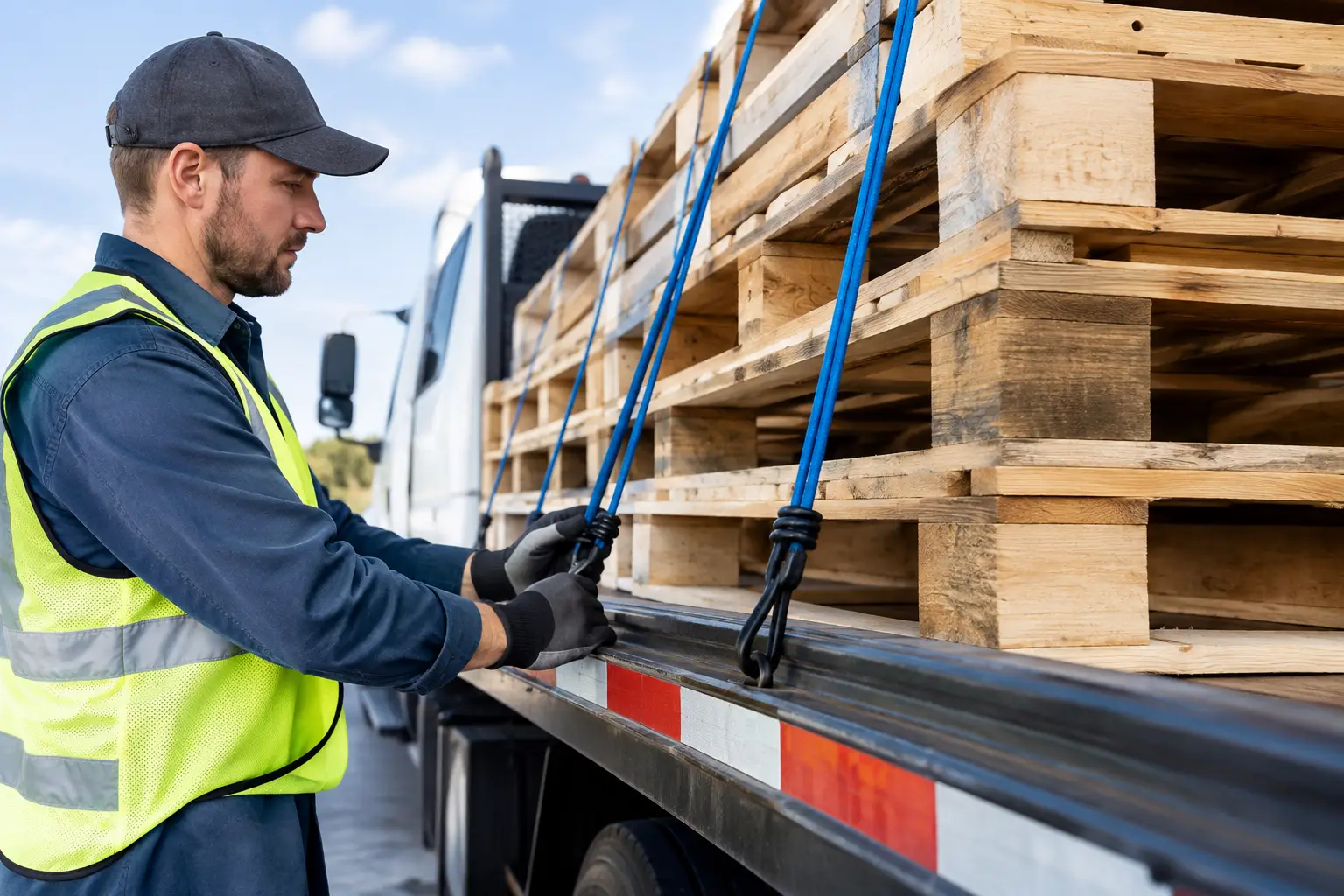
A bungee cord that keeps a tarp tidy or stops a light item shifting in a toolbox is not automatically suitable for restraining freight. For a tautliner or curtain-sided truck, the real question is whether the complete restraint arrangement can keep the load secure under braking, cornering, acceleration and rough-road forces.
So, are bungee restraints compliant? On their own, standard elastic bungee cords are generally not an appropriate primary method of load restraint for commercial freight. Compliance depends on the load, the vehicle, the restraint equipment, its rating and condition, and whether the full system meets the performance expected under Australian load restraint requirements.
Compliance is about the complete restraint system
A restraint is not compliant simply because it holds the load still while the truck is parked. It must control the load when the vehicle is moving and exposed to real operating forces. That includes emergency braking, lane changes, roundabouts, uneven surfaces and the repeated vibration of a long shift.
Australian operators commonly use the National Transport Commission Load Restraint Guide as the practical benchmark for securing loads. The guide sets out performance principles for preventing a load from moving in a way that could affect vehicle stability, injure people, damage the freight or create a road hazard.
For fleet operators, the practical test is straightforward: can the arrangement restrain the load in every direction required for the trip, and can that be demonstrated through correctly selected, rated and fitted equipment? If the answer relies on a bungee stretching tighter as the load moves, it is not a dependable primary restraint strategy.
Why ordinary bungee cords are usually unsuitable
Elastic cords are designed to stretch. That is useful for light-duty retention tasks, but it creates issues when controlling heavy, palletised or unstable freight.
As a bungee stretches, its tension changes. It can allow initial load movement before reaching higher tension, and that movement may be enough to loosen other restraints, damage product or change the load distribution. Elastic products can also deteriorate through UV exposure, abrasion, cuts, damaged hooks and repeated overstretching. Those defects are not always obvious during a quick pre-start check.
A conventional bungee cord may also have no stated lashing capacity, no clear traceability and no evidence that it is intended to restrain the particular freight being carried. Without a verified rating and a suitable restraint method, an operator cannot reasonably treat it as equivalent to a rated strap, chain, barrier or engineered restraint system.
This does not mean every product described as a bungee has no place in transport. Purpose-designed components used within an engineered system may perform a specific retaining or tensioning function. The distinction matters. A component must be assessed as part of the manufacturer’s intended system, not judged by its name or appearance.
Curtains are not a load restraint
Curtain-sided bodies make loading efficient, but the curtains themselves should not be assumed to restrain the freight. Their main role is weather protection and enclosure unless the vehicle and curtain system have been specifically designed, tested and certified to provide load restraint for the intended load.
That matters when operators use elastic cords to pull a load towards a curtain or take up slack around a pallet. Even if the freight looks secure at the depot, it may shift against the curtain during transit. A shifted load creates risk for the driver, the public and anyone opening the side of the truck at the delivery point.
For tautliners, a properly planned restraint arrangement should use suitable restraint points, rated equipment and, where needed, physical containment. The load type determines what is required. A stable, fully packed pallet load is different from steel, machinery, reels, building products, awkward freight or mixed consignments with gaps between pallets.
Are bungee restraints compliant in any situation?
There is no single yes-or-no answer that applies to every elastic product or every vehicle. The better answer is that bungee restraints may only be suitable where their intended use, rating, installation and performance have been established for that specific application.
For example, an engineered bungee-based unit may be part of a purpose-built curtain-side restraint system that is installed to the manufacturer’s instructions and used within defined load limits. In that case, the compliance assessment is based on the system’s design and its ability to restrain the load, not on whether it resembles a household bungee cord.
By contrast, using loose elastic cords as an improvised substitute for rated load restraint equipment is difficult to justify for commercial freight. It introduces uncertainty around capacity, preload, hook security, wear and the amount of movement permitted before the restraint reacts.
Operators should also avoid assuming that a customer’s usual practice is automatically compliant. A method may have been used for years without an incident, yet still leave the business exposed when freight shifts during a hard stop or a roadside inspection identifies inadequate restraint.
What fleet operators should check before dispatch
A practical restraint check starts before the truck leaves the yard. Confirm the freight weight, dimensions, centre of mass, packaging strength and whether the load can slide, roll, tip or move sideways. Then consider the route, including regional roads, multiple delivery stops and whether the load will be partly unloaded during the run.
The restraint equipment must be suitable for the task and connected to appropriate anchor points. Check that straps, tracks, rails, hooks and tensioning components are in sound condition and fitted as intended. Damaged webbing, bent fittings, worn tracks and makeshift attachments should be removed from service rather than worked around.
The loading method matters just as much as the hardware. Blocking, bracing, friction, direct restraint and containment can work together. One restraint method may be sufficient for one load and inadequate for another. The aim is to prevent movement, not merely reduce it.
Drivers need a method they can apply consistently. If a restraint process requires excessive climbing, heavy manual handling or reaching from an exposed position, shortcuts become more likely. A safer system is one that enables the driver to secure freight from a safer working position while maintaining the required restraint performance.
Safety and productivity should work together
Load restraint is often treated as a delay between loading and departure. In practice, poorly designed restraint processes cost time throughout the job. Drivers spend longer fitting equipment, rechecking loose freight, dealing with damaged stock and managing avoidable manual-handling risk.
Purpose-designed systems can reduce those pressures when they are matched to the vehicle and the freight task. For curtain-sided trucks, this may mean integrated track hardware, correctly specified restraint units and tools that allow the driver to position equipment without unnecessary climbing or reaching.
StrapNGo’s patented Australian-made system is designed around this operational reality: helping tautliner and curtain-side operators improve load security with minimal labour, while supporting safer day-to-day handling. As with any restraint solution, it must be installed correctly and used within its specified application.
Document the method and train the people using it
Compliance is stronger when the business can show how it manages the risk. Keep manufacturer instructions, equipment ratings, installation records, inspection processes and training material available to the people responsible for loading and dispatch.
Training should be specific to the freight operation. A driver carrying general pallets for metropolitan deliveries faces different restraint challenges from a driver hauling agricultural products, industrial equipment or interstate mixed freight. The loading plan needs to reflect those differences rather than rely on a one-size-fits-all approach.
Regular inspections are also essential. Elastic components, straps and fittings are consumable safety equipment in a hard-working environment. Dirt, sun, water, forklift contact and repeated use all take a toll. Replace damaged items promptly and investigate any load movement, even where no damage or injury occurred.
The safest approach is to treat bungee-style equipment as a specialised component, not a shortcut. If the restraint method cannot show that it will control the load throughout the journey, select a properly rated and engineered alternative before the truck rolls out.