
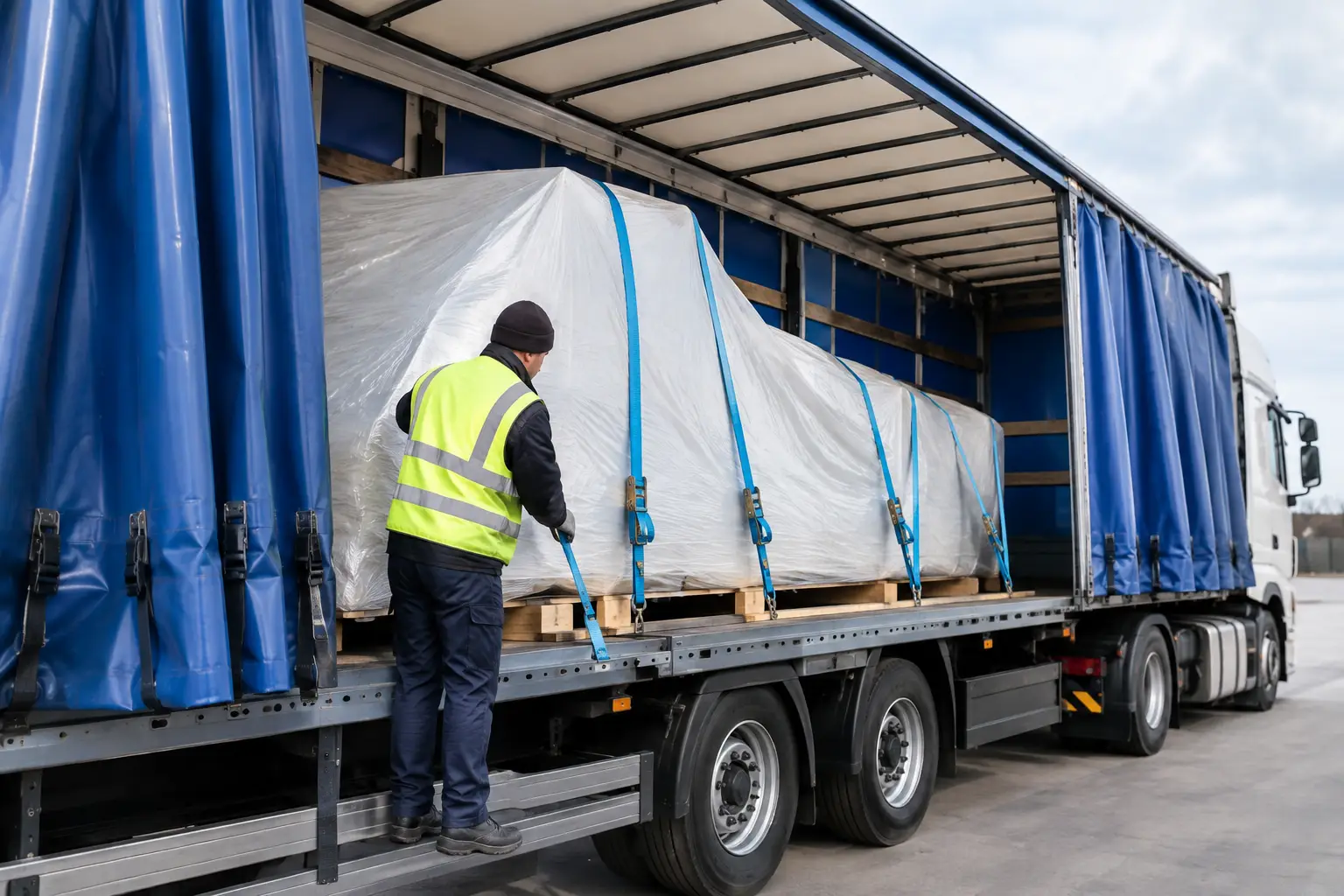
A pallet of uniform cartons is predictable. An awkward machine frame, mixed steel lengths, oversized crate or uneven agricultural component is not. Knowing how to secure irregular freight means dealing with the load you actually have, not trying to force it into a standard restraint routine. In a curtain-sider or tautliner, that starts with recognising that curtains provide weather protection and containment, not primary load restraint.
Irregular loads demand more planning because their weight, shape and contact points can work against the restraints used to hold them. The right approach protects the driver, the public and the load, while keeping loading practical enough for a busy transport operation.
Start with the load, not the straps
Before loading, assess the freight as a complete unit. Identify its mass, dimensions, centre of gravity, likely movement points and any sharp or fragile edges. Ask where it can safely be restrained without damaging the product or allowing a strap to slip.
A load can appear stable while stationary and still become a problem under braking, cornering or rough road conditions. Tall items may have a high centre of gravity. Long items can shift lengthways. Round or tapered freight can roll or move sideways. A mixed load may contain several pieces that react differently to the same restraint force.
The restraint method must suit those risks. This is particularly important where freight is not supplied on a pallet, has no obvious tie-down points, or is loaded beside other items with gaps between them. Do not assume the load will stay in place because it is heavy. Weight does not prevent movement when the truck is braking hard or negotiating a roundabout.
Build a stable loading plan
Load placement is the first restraint. Position the heaviest freight as low as practical and distribute weight to suit the vehicle, axle limits and the body configuration. Keep the centre of gravity low and avoid placing heavy irregular items on top of lighter or unstable freight.
Where possible, place the load against a suitable headboard or other rated blocking point. If freight cannot be loaded tight together, manage the gaps with appropriately rated blocking, bracing or dunnage. Empty space gives irregular freight room to gather momentum before it meets a restraint.
Dunnage needs to be sound, suitable for the load and positioned to support it properly. It can protect the deck, provide clearance for handling equipment and help prevent rolling or sliding. But it is not a substitute for restraint. Timber that splits, shifts or crushes under load can create more movement rather than less.
Consider the unloading sequence as well. A load that is secure when the doors are shut may create a release risk if restraints need to be removed while freight is still leaning, under pressure or unsupported. Plan for the driver to release restraints from a safe position wherever possible.
Control rolling, sliding and tipping separately
Irregular freight often has more than one movement risk. Cylindrical or curved items may roll. Smooth-bottomed equipment may slide. Tall or narrow items may tip. Each risk needs a control that is fit for purpose.
For example, chocks or cradles may help stop a round item from rolling, while direct restraint and suitable blocking control forward, rearward and sideways movement. A strap laid over an item may assist with downward restraint, but it may not stop the item moving lengthways unless the overall restraint arrangement has been designed for that purpose.
Use edge protection where a restraint passes over sharp corners or rough surfaces. This protects both the webbing and the freight, and helps maintain restraint effectiveness. Never run damaged webbing over an edge and expect it to perform as intended.
Choose restraint equipment for the job
Restraint equipment must be rated, in serviceable condition and compatible with the truck body and load. Check strap webbing for cuts, abrasion, burns, contamination and damaged stitching. Inspect ratchets, hooks, fittings, tracks and anchor points for distortion, cracks, corrosion or signs of overload.
The rating of the restraint is only one part of the equation. The truck body anchor point, track, hook connection and load contact point must also be capable of supporting the forces involved. A good strap connected to an unsuitable point is not a compliant or safe system.
For curtain-sided trucks, an integrated internal restraint arrangement can reduce the need for drivers to repeatedly climb, reach across freight or work close to live traffic. StrapNGo is a patented Australian-made system designed for tautliners and curtain-siders, using internal track, bungee units and an extendable pole with hook to help secure freight with minimal labour.
That does not mean one system suits every load without assessment. Very heavy machinery, unusual shapes, dangerous goods or freight with specialised securing requirements may need additional controls, purpose-built frames or advice from the freight supplier. The principle remains the same: select equipment based on the load and the forces it must resist, not simply what is quickest to fit.
How to secure irregular freight safely in a tautliner
Once the freight is positioned and supported, apply restraints in a sequence that keeps the driver out of unnecessary risk. Work from a stable position and avoid climbing onto tyres, side rails, pallets or the load itself to throw straps. If an item cannot be restrained without unsafe reaching or climbing, the loading method needs to change.
Bring restraints into contact with the load so they are correctly aligned and not twisted. A twisted strap can be damaged more easily and may not sit correctly under tension. Ensure hooks are fully engaged and cannot detach as the load settles. Keep restraints clear of sharp edges unless suitable protection is in place.
Tension should be firm and even, but excessive tension can damage fragile freight, crush packaging or overload parts of the restraint system. Check whether the load has settled after the first restraint is applied. It is often necessary to adjust the position of a strap, add blocking or apply a second restraint in another direction.
For mixed freight, secure the major irregular item first, then restrain surrounding freight so it cannot move into the protected space. Avoid relying on a lighter load to brace a heavier one. If a heavy item shifts, the lighter freight will not hold it.
Keep people clear during loading and unloading
The restraint process should reduce exposure to pinch points, falling freight and roadside hazards. Establish a clear exclusion area around forklifts and moving loads. The driver and loader should agree on the sequence before work begins, particularly where the freight is oversized or difficult to handle.
Curtains should not be treated as a barrier that makes an unstable load safe. Before opening a curtain or rear doors, look for signs that freight has moved in transit. If there is any concern, stop and assess how the load can be made safe before releasing restraints.
This is where low-labour restraint systems offer a practical safety benefit. When drivers can operate the restraint from a safer position using the correct equipment, there is less pressure to take shortcuts such as climbing onto the deck or reaching over an unstable load.
Complete a proper pre-departure check
Before the truck moves, inspect the load from both sides where safe to do so. Confirm the freight is stable, restraints are tensioned and correctly connected, edges are protected, and no loose equipment can move during transport. Check that curtains, doors and other body components are properly secured.
A useful final check is to ask what will happen under emergency braking, a sharp turn and road vibration. If the answer is that the freight could slide, roll, tip, settle or strike another item, revise the arrangement before departure.
Load restraint is not a set-and-forget task. Recheck restraints during the journey, especially after the first section of travel, after rough roads, after significant braking or whenever the load condition may have changed. Webbing can settle, dunnage can compress and irregular freight can shift into a new position.
The safest way to move an awkward load is rarely the fastest-looking method at the start. Take the time to assess the shape, control its movement in every direction and use restraint equipment that suits the truck and the job. That is how drivers go home safer and freight arrives where it should.