
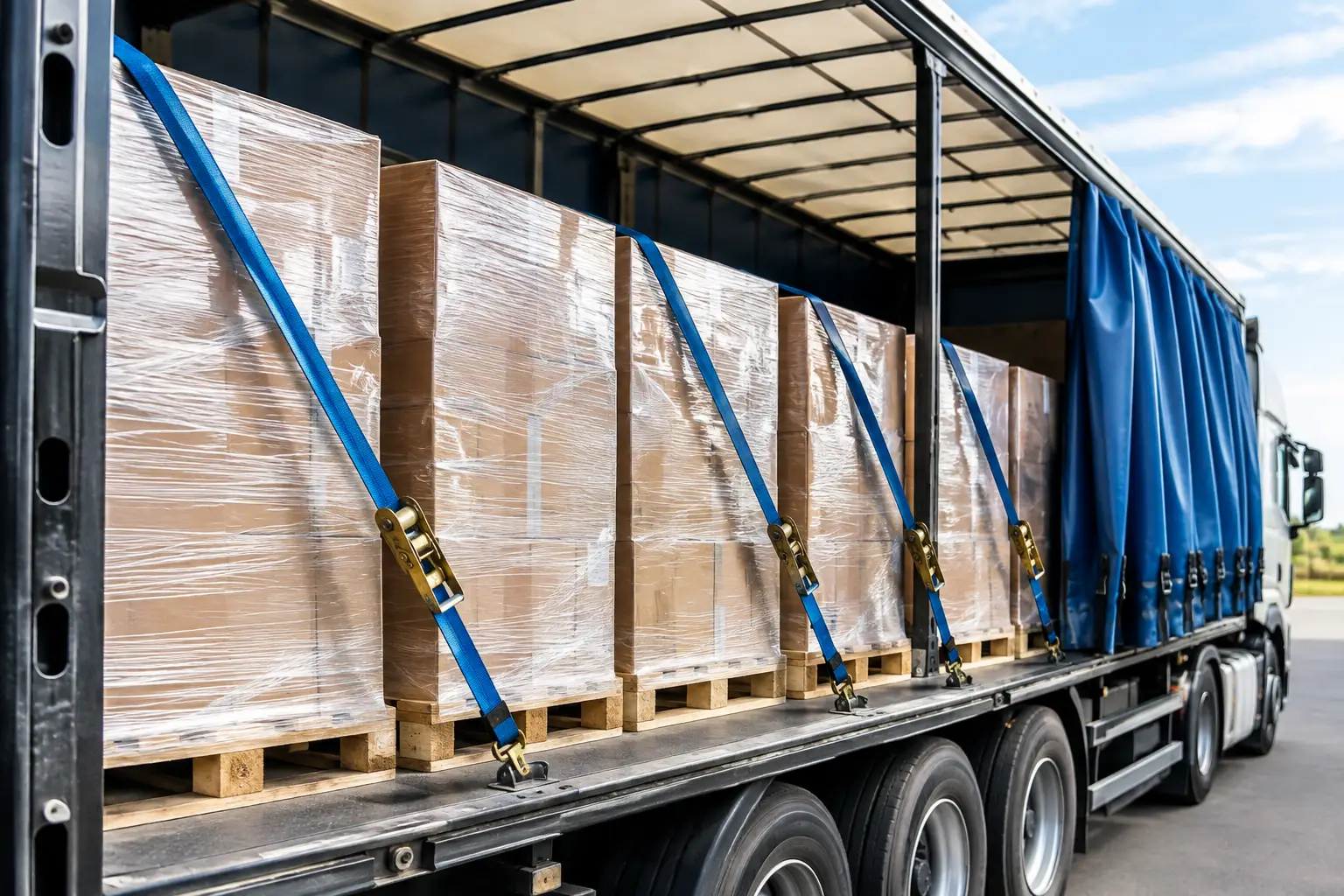
A pallet can look settled when the curtains are closed, then move the moment the truck brakes hard, takes a roundabout or runs across uneven road. Five pallet movement controls give drivers and fleet operators a practical way to manage that risk before the vehicle leaves the dock. The aim is not simply to stop freight falling over. It is to create a restraint arrangement that suits the load, the truck body and the work being performed.
For tautliners and curtain-sided trucks, pallet control starts well before a strap is tensioned. Load condition, pallet placement, restraint equipment and the way drivers access that equipment all affect the final outcome. Getting these details right supports safer loading, fewer delays and less physical strain across daily freight work.
Why pallet movement needs active control
Road transport places freight under forces that are easy to underestimate from the loading bay. Braking drives the load forward. Acceleration can move it rearward. Cornering, evasive manoeuvres and road camber can create lateral movement. A loose pallet may also transfer force into the pallets beside it, causing a wider load shift.
Curtains are primarily weather protection and enclosure. They should not be assumed to restrain freight unless the complete truck body and restraint arrangement have been specifically designed and assessed for that purpose. The restraint plan must deal with the pallet load itself, not rely on the curtain to compensate for gaps or poor placement.
The NHVR Load Restraint Guide 2025 provides useful direction for considering load restraint performance. However, compliance depends on the complete arrangement, including the load, vehicle, equipment condition, installation and the applicable legal requirements. A good operating procedure gives drivers clear controls while allowing for the different freight they carry each day.
Five pallet movement controls for tautliners
1. Start with a stable pallet and sound load unit
No restraint system can fully correct a pallet that is already unstable. Before loading, check that the pallet is not cracked, broken, wet or distorted, and that the product is evenly supported. Cartons that overhang the pallet, damaged stretch wrap and a high, uneven stack all increase the chance of movement.
This check matters most with mixed freight. A tightly wrapped, square pallet of bagged product behaves differently from a light pallet with loose cartons or tall, narrow boxes. If the load unit is poor, it may need to be rewrapped, repalletised or placed where it can be controlled with suitable containment and restraint. Sending it out because the delivery is urgent simply shifts the problem onto the driver and the road.
2. Position pallets to limit empty space
Gaps allow pallets to build momentum. When the truck changes speed or direction, even a small gap can become enough room for a pallet to shift, lean or strike another load. Load pallets close together where practical, while maintaining a safe and workable loading sequence.
Weight distribution also needs attention. Place heavier freight in a position that supports axle loading requirements and vehicle stability, rather than concentrating mass in one area for convenience. The best layout depends on the truck, the delivery run, unloading order and the type of freight. A multi-drop run may require planned spaces, but those spaces still need to be managed with an appropriate restraint method.
Where a gap cannot be avoided, treat it as a restraint issue, not a visual inconvenience. Select equipment and a load arrangement that prevents the freight from moving into that space. Do not use damaged pallets, loose packaging or unsuitable materials as makeshift fill.
3. Restrain the load in every relevant direction
A restraint system must address the directions in which the freight can move. That usually means considering forward, rearward and sideways forces, rather than placing one strap over a pallet and assuming the job is complete. The equipment must be suitable for the load, correctly rated, in serviceable condition and connected to appropriate vehicle anchorage points.
The restraint method should suit the cargo. Direct restraint, tie-down restraint, blocking and containment can each have a role, but they are not interchangeable. A method that works for dense, low pallets may be unsuitable for light, tall or irregular freight. Friction between the pallet and deck can help, yet it should not be treated as the sole control unless the entire arrangement has been assessed accordingly.
Drivers also need enough access to apply the restraint without climbing on the load or reaching into an unsafe position. A restraint that is technically possible but difficult to use properly will often be rushed, skipped or applied inconsistently when the pressure is on.
4. Use track-mounted equipment that reduces handling exposure
Traditional load restraint can require a driver to drag straps, throw equipment over freight or work close to the traffic side of the vehicle. Those tasks add manual handling and roadside exposure to a process that may be repeated many times in a shift.
A properly selected track-mounted system can make pallet restraint more controlled and repeatable. StrapNGo’s patented, Australian-made load restraint system is designed for tautliners and curtain-sided trucks to help drivers position and secure freight with minimal labour. The track, bungee unit and extendable pole with hook are intended to reduce unnecessary reaching and handling when used as part of a suitable complete restraint arrangement.
The trade-off is that installation and equipment selection must suit the truck body and operating task. A system should be installed correctly, inspected regularly and matched to the freight types carried. Fleet operators should also ensure drivers understand the correct loading sequence, connection points and limitations of the equipment.
5. Check the load before departure and at practical intervals
The final walk-around is not a formality. Before departure, check pallet condition, load placement, strap tension, anchor connections, track condition and any gaps that could permit movement. Confirm that curtains, gates and doors are correctly closed and secured, but do not confuse those closures with freight restraint.
During a run, stop and recheck when the work changes. A check is particularly worthwhile after the first part of the journey, after heavy braking, after travelling over poor road surfaces or when remaining pallets have been exposed by a delivery. Multi-drop work can substantially change the load distribution and restraint needs inside the body.
Equipment inspections should be built into the maintenance routine as well. Look for worn webbing, damaged hooks, distorted track, loose fixings and components that do not operate as intended. Remove damaged equipment from service and replace it before it becomes the weak point in an otherwise sound arrangement.
Make the controls part of the loading process
The most reliable pallet movement controls are the ones that fit normal operations. A driver should not need to invent a new method at every dock. Document the expected load layouts for common freight, train drivers and loading staff in the required process, and give them the authority to stop a load that is unstable or cannot be safely restrained.
For fleet managers, this is also a productivity issue. Preventing a load shift can avoid rework, freight damage, delayed deliveries, incident reporting and downtime. Reducing unnecessary climbing, reaching and strap handling helps protect the people doing the job as well.
A safe load does not rely on one strap, one curtain or one final check. It comes from stable pallets, deliberate placement, suitable restraint and drivers who have the equipment and time to do the job properly before the truck moves.