
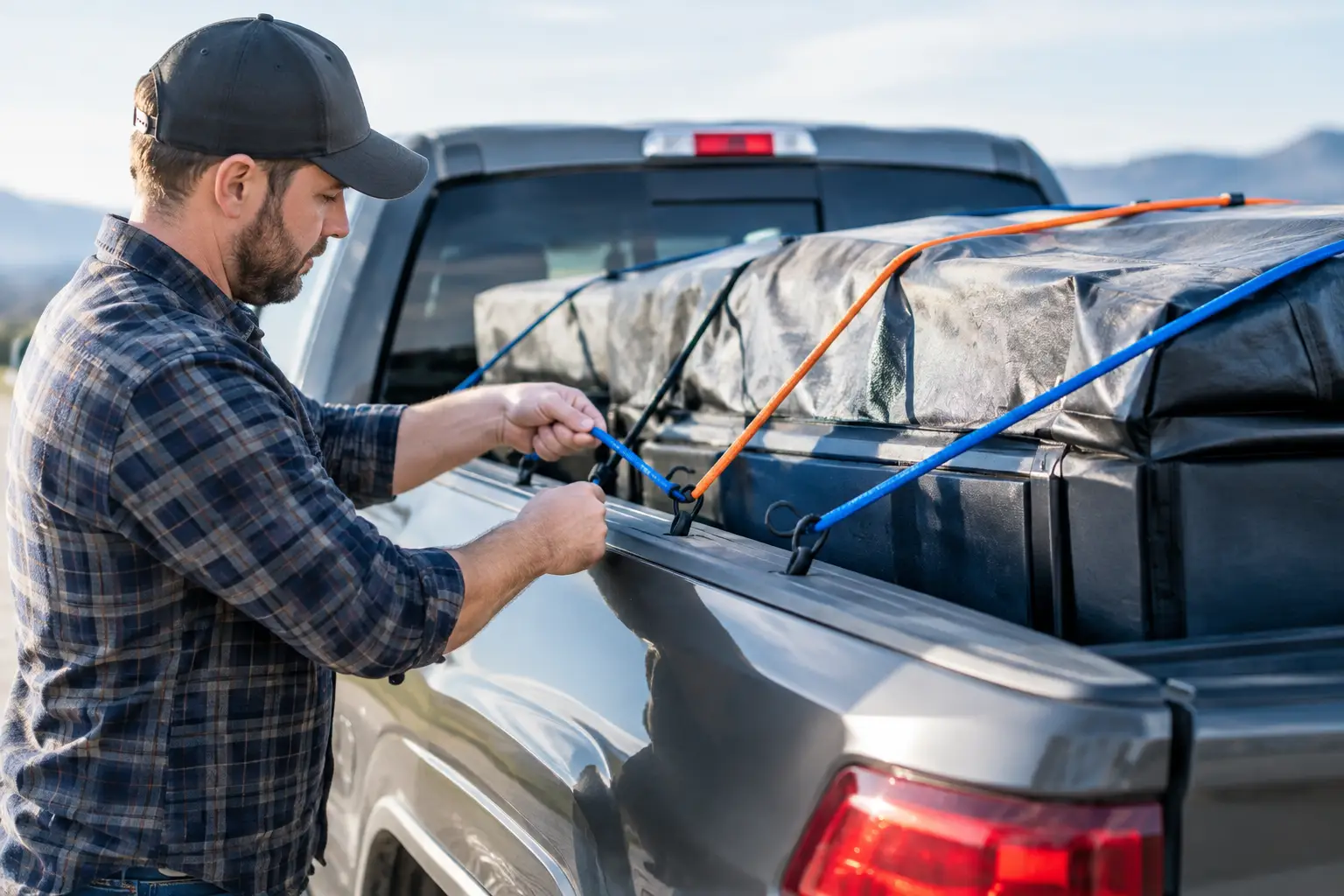
A bungee that is too light for the job can leave a curtain-side load exposed. One that is too heavy, poorly positioned or difficult to reach can create a manual handling problem for the driver. Choosing truck bungees correctly is not just about buying an elastic cord with hooks. It is about selecting equipment that suits the freight, the truck body, the restraint arrangement and the way your drivers work.
For tautliners and curtain-sided trucks, the bungee is often a working part of a broader load restraint system. It needs to perform consistently through repeated loading cycles, changing weather and demanding freight schedules. The right choice can reduce handling time and help drivers secure loads from a safer position. The wrong choice can introduce unnecessary strain, damage equipment or encourage shortcuts when the pressure is on.
Start with the restraint task, not the bungee
The first question is what the bungee is required to do within the load restraint arrangement. A bungee may help position or retain a restraint component, support curtain management, or work as part of a purpose-designed system. It is not automatically a substitute for correctly rated tie-down equipment, blocking, bracing or other restraint measures required for the load.
Every load behaves differently. Palletised freight, machinery, building products, bagged goods and mixed consignments each present different risks. Consider the load mass, shape, stability, friction between the load and deck, available anchor points, and the forces likely to act during braking, cornering and acceleration. The route also matters. Metropolitan multi-drop work creates frequent handling cycles, while interstate work may expose equipment to longer vibration, weather and road variation.
Australian operators should assess the complete arrangement against applicable loading performance requirements and current NHVR guidance. The bungee unit is one component. Compliance depends on the full system, correct installation, equipment condition and the way the load is secured on the day.
Choosing truck bungees correctly means matching the system
A truck bungee should suit the track, anchor point and operating method it is designed to work with. Avoid mixing components simply because they appear to fit. An improvised hook, an incompatible rail or a substitute cord may alter how force is transferred through the restraint arrangement and can increase the chance of release or damage.
For curtain-sided trucks, purpose-designed bungee units and tracks provide a more consistent approach than ad hoc solutions. The hardware should be selected around the truck body configuration, including track location, curtain clearances, internal load space and access from ground level. If the truck is part of a fleet, standardising the arrangement across similar bodies can also make driver training, inspections and replacement parts far more straightforward.
StrapNGo’s patented Australian-made system is designed for tautliners and curtain-sided trucks, combining bungee units, track and an extendable pole with hook to support lower-labour load restraint practices. As with any system, suitability must be assessed for the vehicle, freight task and complete restraint arrangement.
Check strength, stretch and working condition
Elastic equipment is not all the same. The cord material, diameter, construction, hook design and attachment method influence durability and performance. A bungee must be suitable for its intended application, but selecting the highest apparent strength is not always the answer. Excessive tension can make it difficult to operate, increase recoil risk and place extra stress on attachment points. Too little tension may allow slack, movement or unreliable retention.
Look at how the bungee behaves in real working conditions. It should provide controlled tension without requiring a driver to overreach, pull from an unstable stance or work close to the line of recoil. It should also return predictably after use. If the cord has become permanently stretched, frayed, cut, flattened or contaminated, it is no longer performing as intended.
Hooks deserve the same attention as the elastic section. They need to engage fully with the intended track or fitting and remain secure under normal operating movement. Bent hooks, damaged gates, sharp edges and worn attachment points are all reasons to remove equipment from service. A hook that is only partially seated may release without warning.
Design out manual handling risk
A restraint method can be technically effective but still create a poor outcome if it repeatedly puts drivers in awkward positions. This is where bungee selection and system layout have a direct safety impact.
Drivers should be able to engage and release bungees without climbing where possible, leaning out through curtain openings or working from slippery surfaces. An extendable pole can help keep the operator on the ground when accessing higher track positions. That reduces exposure to falls and can limit the shoulder, back and wrist strain that builds up across a full shift.
Consider the actual loading sequence. If a driver must walk back and forth along the truck, handle multiple loose components or repeatedly reset a bungee because it is hard to position, productivity suffers. A properly planned arrangement should support a repeatable process: load the freight, apply the required restraint components, tension and secure them using the designated hardware, then complete the relevant checks before departure.
The safest method is often the one drivers can perform correctly every time, including during rain, poor light, tight delivery windows and unfamiliar sites.
Select for the operating environment
Australian transport work is hard on equipment. Sun, heat, road grime, water, dust and diesel residue all affect bungee material over time. A unit that looks acceptable from a distance may have ultraviolet deterioration, hidden cuts or corrosion around the hook connection.
For fleets operating across different regions, inspect whether the selected bungee material and fittings are appropriate for the environments encountered. Coastal work can accelerate corrosion. Construction and quarry work may expose equipment to abrasive dust. Food and grocery distribution can mean high-frequency use across multiple drops every day. The right specification depends on the task, but the inspection routine should be consistent across all of them.
Store spare units clean and dry, away from direct sunlight where practical. Do not leave them tangled in toolboxes or thrown loose behind the cab. Poor storage shortens service life and makes it harder for drivers to identify damaged equipment before it is needed.
Build inspections into the daily routine
A bungee should be checked before use, not only when something goes wrong. This does not need to become a lengthy paperwork exercise, but it does need to be deliberate. Drivers and workshop staff should know what unacceptable wear looks like and have a clear process for quarantining defective equipment.
Before loading, check four areas:
- the elastic section for cuts, fraying, cracking, permanent stretch or loss of tension
- hooks and connectors for bends, corrosion, sharp edges, distortion or insecure attachment
- tracks, rails and anchor points for damage, loose fittings, obstruction or wear
- the final engagement to confirm the bungee is seated correctly and not rubbing on a sharp edge
Do not repair a damaged bungee with knots, tape, cable ties or non-approved fittings. A temporary fix can change tension, hide deterioration and create an unpredictable release point. Replace it with the correct component for the system.
Train for the real job, not the ideal job
New equipment only improves safety when drivers understand its purpose and correct use. Training should cover more than how to hook on and unhook. Drivers need to know where the bungee fits in the load restraint arrangement, when it must not be used as a substitute for another restraint method, how to recognise damage and how to avoid standing in a potential recoil path.
Short practical demonstrations are effective because they reflect the work drivers actually do. Use the truck body, the usual freight and the same access conditions encountered on site. Workshop teams should also be included, particularly where they install tracks, replace hardware or inspect equipment during servicing.
It is worth collecting feedback after implementation. If drivers report that a position is hard to reach, a hook is difficult to seat or the process changes between truck bodies, address it before it becomes normalised. Small layout adjustments can remove a repeated source of strain and save time at every load.
Buy for service life, not just unit price
The cheapest bungee can be expensive if it requires frequent replacement, slows loading or contributes to damage and incidents. Assess the whole-of-life value: material quality, compatibility with the installed system, availability of replacement parts, ease of inspection and support from the supplier or installer.
For fleet operators, standardisation usually delivers better control than sourcing whatever is available at short notice. It simplifies procurement, reduces training variation and gives drivers confidence that the same procedure applies across the fleet. Owner-drivers benefit from the same principle: use equipment you understand, inspect it regularly and replace it before wear becomes a risk.
A truck bungee may look like a small item, but it affects how safely and efficiently a driver can complete the job. Choose it as part of a complete, purpose-designed load restraint arrangement, and give your drivers equipment that works with them rather than against them.