
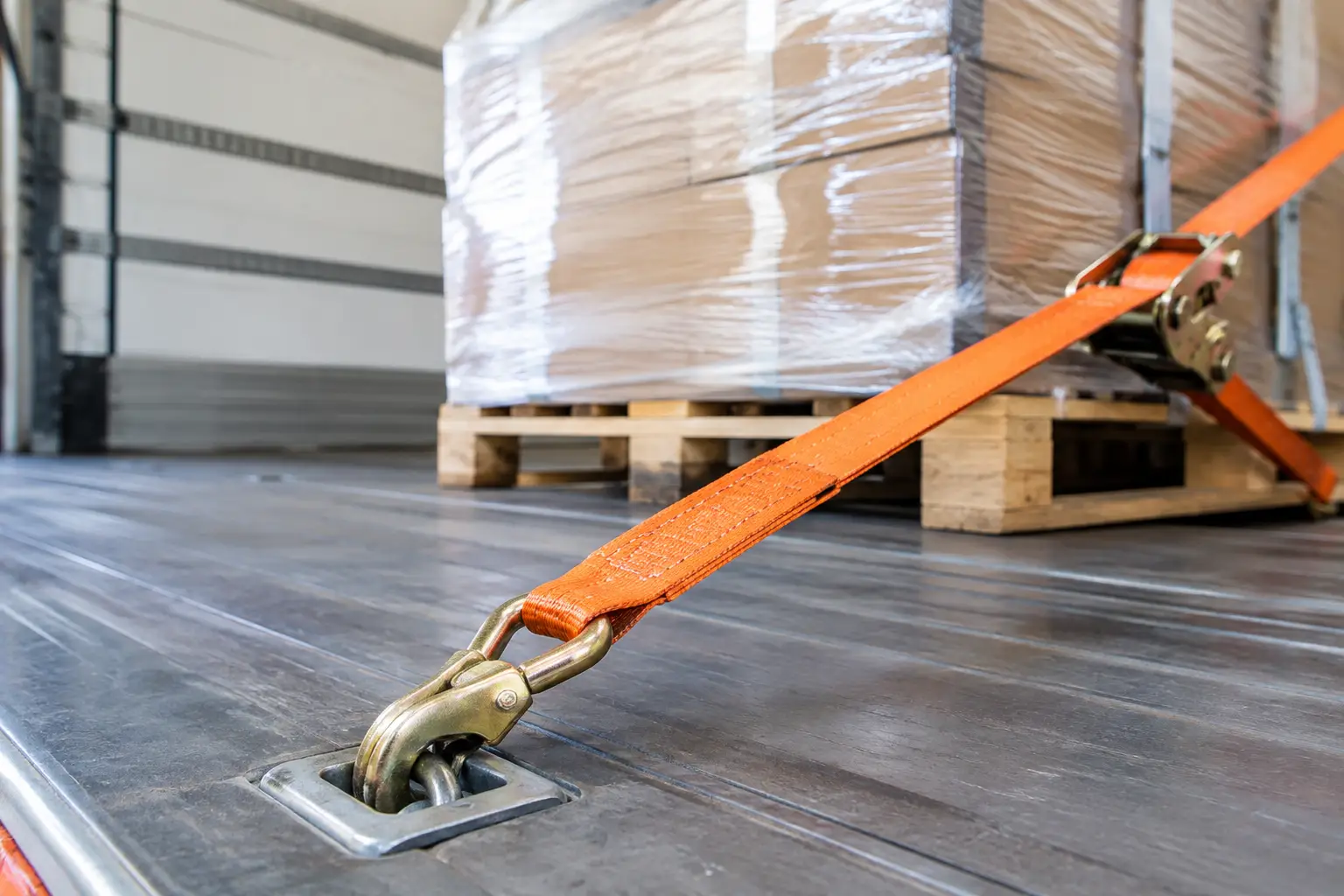
A restraint system is only as strong as the point it is connected to. Restraint anchor ratings tell operators how much force an anchor point or track arrangement is designed to withstand, but the rating is not a blanket approval for every load, strap or loading method. For curtain-sided trucks and tautliners, understanding that difference is critical to safer loading, better equipment selection and practical compliance.
A strap can look heavy-duty, an anchor can be bolted to the body, and the freight can appear secure at the start of the trip. None of that proves the complete arrangement will control the load under braking, cornering, rough road conditions or an evasive manoeuvre. The job is to assess the whole load restraint system, not one component in isolation.
What restraint anchor ratings actually mean
A restraint anchor rating is the capacity assigned to a designated anchorage point, rail or track for use in a load restraint arrangement. It should be supported by the equipment manufacturer’s specifications, installation requirements and clear identification where applicable. The rating helps determine whether the anchor can be used for the forces expected in service.
That does not mean an anchor rating is the same as the rating of a strap, chain, rope or curtain. Each item has its own capacity, and the usable capacity of the arrangement is limited by its weakest component. A high-capacity track cannot make an under-rated strap suitable. Equally, a strong strap does not compensate for an anchor point, fixing or truck body structure that is not designed for the load force involved.
For fleet operators, the practical question is not simply, “What is this anchor rated to?” It is, “Can this installed restraint arrangement safely control this particular load in this vehicle, in the directions it needs to be restrained?”
The anchor is part of a complete restraint system
Load restraint performance relies on several connected parts working together. In a tautliner, this may include the truck body structure, restraint track, track fixings, anchors, straps or other restraint devices, tensioning method, load contact points and the freight itself. A fault in any one of these areas can reduce the performance of the whole arrangement.
The anchor’s location also matters. An anchor placed too high, too low or too far from the freight can create poor restraint angles. That may reduce the effective force applied to the load or create a greater load on the anchor and strap than operators expect. A strap running across the top of a pallet can assist with tie-down restraint, for example, but it is not automatically providing the direct forward restraint required to control the load under hard braking.
The National Heavy Vehicle Regulator’s Load Restraint Guide provides the broader framework: a load must be restrained to prevent unacceptable movement during normal driving conditions. Anchor ratings support that outcome, but they are not a replacement for calculating or assessing the required restraint forces.
Curtains are not usually the answer
A common risk with curtain-sided vehicles is treating the curtain as the primary load restraint. Standard curtains are generally weather protection and containment equipment, not a substitute for a correctly designed load restraint system. Unless a specific curtain system is engineered, rated and used in accordance with its documented limitations, freight should be restrained independently using suitable internal equipment.
This is particularly relevant for palletised loads, mixed freight, machinery, long products and irregular loads. The curtain may stop loose packaging from blowing out, but it cannot be assumed to hold a shifting load in an emergency stop.
Why labels, records and installation details matter
An anchor rating only has value when operators can identify what the equipment is, how it was installed and what conditions apply to its use. Missing labels, unverified modifications and unknown body repairs introduce doubt that should be addressed before the equipment is relied upon.
For workshop and fleet teams, records should establish the track or anchor manufacturer, the stated rating, installation method, compatible restraint equipment and any inspection or maintenance requirements. This is especially important when purchasing used trailers, changing body layouts or adding restraint hardware after the vehicle has entered service.
Installation cannot be separated from rating. A track may have a published capacity when fitted to a specified body structure with prescribed fasteners and spacing. If it is fitted to a weaker panel, altered without engineering advice or damaged by impact, its original rating may no longer reflect its actual performance. The same applies where corrosion, cracked welds, loose fasteners or deformed track sections are present.
A practical pre-start inspection should include a look at anchor points and track for deformation, wear, cracking, corrosion, damaged slots, loose fixings and contamination that may prevent proper engagement. Straps, buckles, hooks and tensioning devices should be checked at the same time. If the equipment is questionable, take it out of service until it can be assessed or replaced.
Restraint anchor ratings and restraint direction
Freight does not only move forwards. A load restraint arrangement needs to address forward, rearward and sideways movement, along with vertical movement where lifting or bouncing is possible. The force requirements and suitable methods vary with the load, vehicle, deck surface, packaging, restraint angles and operating conditions.
Anchor points are often used in different directions, yet not every anchorage is suitable for every direction of pull. Operators should follow the manufacturer’s instructions and the vehicle body builder’s guidance rather than assuming a point can carry the same load from any angle. Side loading, sharp bends around edges and connecting multiple devices to one point can all change the forces involved.
Direct restraint and tie-down restraint also work differently. Direct restraint uses the device to resist movement in a particular direction. Tie-down restraint increases downward force to improve friction between the load and deck. Both may have a place, but a tie-down arrangement depends heavily on friction, tension and angle. Wet decks, smooth packaging, damaged pallets and low-friction materials can make friction-based restraint less dependable.
Where the freight is high-risk, unusually heavy, difficult to restrain or regularly loaded in mixed configurations, seek competent technical advice on the vehicle-specific restraint arrangement. A generic rating stamped on a component is not enough to resolve a complex loading problem.
Match the equipment to the task
A sound restraint plan starts before the truck arrives at the dock. The load weight, dimensions, centre of gravity, packaging condition and load distribution should determine the equipment and method selected. It is safer and faster to use a consistent, fit-for-purpose arrangement than to improvise around a difficult load once it is on the deck.
For curtain-sided operations, an integrated internal track and restraint system can help drivers secure freight from a safer working position and reduce repetitive manual handling. The benefit is not simply fewer steps. It is a controlled method that gives the driver suitable connection points at the right locations, provided the system is correctly installed and used within its stated limits.
StrapNGo’s patented Australian-made system is designed for this operating environment, supporting safer, lower-labour load restraint practices in tautliners and curtain-sided trucks. As with any restraint equipment, suitability depends on the full arrangement, the load being carried, correct installation and applicable legal requirements.
Make ratings part of everyday loading discipline
The best time to find a restraint issue is before the vehicle leaves the yard. Drivers need clear instructions on approved loading patterns, anchor use, restraint equipment and when to escalate a load that does not fit the normal method. Dispatch teams and warehouse staff also need to understand that loading speed cannot come at the expense of access, restraint angles or safe placement of equipment.
A useful fleet process is to review restraint anchor ratings whenever a vehicle body is modified, a new freight type is added, equipment is replaced or an incident reveals load movement. This keeps the assessment connected to real operations rather than filed away as a one-off compliance exercise.
Rated anchors are a foundation, not a finish line. When the anchor, track, restraint device, vehicle body and loading method are matched to the task, drivers have a safer way to secure freight and fleets have a more dependable operation on every run.