
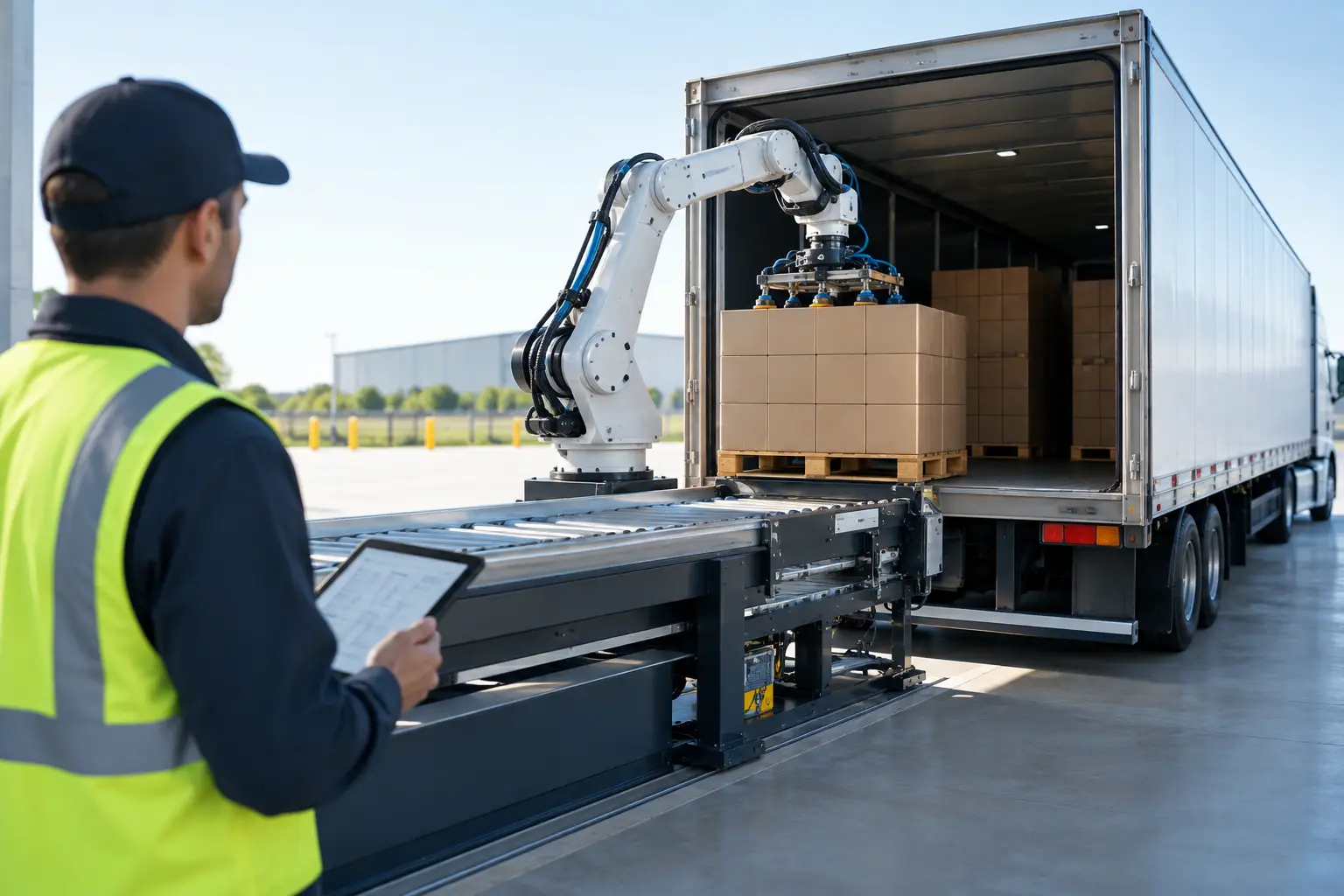
A curtain-sided truck can lose valuable time before it even leaves the yard. Drivers may be climbing, reaching over freight, handling straps repeatedly and working close to live traffic or moving forklifts. The freight loading automation trends gaining traction in Australia are focused on removing those risks and delays from ordinary loading work – not replacing experienced drivers or warehouse crews.
For fleet operators, the practical question is not whether every part of loading can be automated. It is where automation delivers a clear safety and productivity return. In tautliners and curtain-siders, that usually starts with load restraint: reducing manual handling, keeping people on the ground where possible and making the restraint process more consistent across the fleet.
Freight loading automation trends that matter
The most useful automation is often not a fully automated warehouse system. It is equipment that removes a repetitive, high-risk action from a driver’s shift. This includes powered loading docks, automated vehicle positioning, warehouse management systems that sequence loads, and restraint systems designed to be fitted and operated with minimal physical effort.
For transport operators running mixed freight, the last point is particularly relevant. A truck may collect from several sites in a day, carry pallets of different sizes and load in yards where there is no fixed automation. The restraint method needs to work in those conditions, not only at a purpose-built distribution centre.
Automation is moving closer to the truck
Large distribution centres continue to invest in conveyors, pallet handling technology and automated storage systems. Those systems can improve throughput inside the shed, but they do not automatically solve the work performed at the side of the truck.
That is why more attention is turning to vehicle-based equipment. Tracks, restraint systems, poles, hooks and hardware that allow a driver to secure freight from a safer position can produce an immediate operational benefit. Rather than relying on a driver to throw straps over or climb to reach restraint points, the process is designed around repeatable handling from ground level or a controlled position.
This is a more realistic form of automation for many Australian fleets. It can be applied progressively, truck by truck, without rebuilding an entire depot or changing every customer’s loading process.
Manual handling reduction is a core driver
Transport businesses are under constant pressure to reduce manual handling exposure. Shoulder strain, back injuries, slips and falls can stem from tasks that seem routine until they are repeated hundreds of times over a working week.
Loading automation is increasingly being assessed through this lens. A system that reduces reaching, climbing and heavy repetitive handling may help lower risk for drivers while also making the job less physically demanding. That matters for retention as well as safety. Skilled drivers are difficult to replace, and a fleet that makes everyday work safer has a practical advantage.
The right outcome is not simply fewer steps. It is fewer unnecessary high-risk steps. A restraint method still needs to hold the load securely and suit the freight being carried. Any change should be assessed against the load, vehicle body, operating conditions and applicable restraint requirements.
Consistency is becoming as valuable as speed
Fast loading is useful only when freight leaves secure and drivers are not forced to correct mistakes on the road. One of the strongest arguments for automation is consistency. Standardising the way restraints are positioned and operated reduces variation between drivers, shifts and depots.
That does not mean every load is identical. Awkward freight, part loads, multi-drop work and unusual pallet configurations still require a competent operator to make a judgement. But a well-designed system gives that operator a more controlled starting point. It helps make the correct method easier to repeat.
For fleet managers, consistent restraint processes also simplify training. New drivers and relief drivers can be shown a clear operating method rather than learning a collection of informal workarounds. Workshop teams can inspect known components and identify wear before it creates a problem.
Data will support loading decisions, not replace them
Telematics, electronic proof of delivery and warehouse systems are already providing fleet operators with more information about dwell time, load movements and vehicle utilisation. The next development is using that information to identify where loading delays occur and where manual work is creating exposure.
For example, a fleet may find that a particular route has longer turnaround times because drivers are repeatedly repositioning restraints, waiting for access equipment or dealing with inconsistent loading practices. The answer may be better dock planning. It may be a change to the truck body specification. It may be a safer restraint system that cuts down the handling required at each stop.
Data is useful when it leads to a practical change. Measuring every action without improving the work only adds administration. Fleet operators should focus on information that helps them reduce dwell time, improve utilisation and protect people.
The limits of full automation on Australian freight work
Fully automated loading systems can suit high-volume operations with standard pallets, fixed docks and predictable freight profiles. They can be effective, but they require capital investment, facility changes and disciplined load standardisation. For many regional carriers, general freight operators and multi-customer fleets, those conditions do not exist.
Australian freight work is often variable. A vehicle may be loaded at a major DC in the morning, make deliveries through industrial estates, then collect from a customer with limited yard space. Different body types, different loads and different site conditions make a one-size-fits-all automated solution difficult.
That is why semi-automated, vehicle-integrated equipment is likely to remain a major part of the market. It gives operators a way to improve safety and reduce labour without assuming every job happens on a perfect dock.
There is also a maintenance trade-off. More powered equipment can mean more components to inspect, service and repair. Fleet managers should weigh the savings in labour and time against maintenance capability, parts availability and the cost of downtime. Simple, durable systems with clear inspection requirements are often the better commercial choice.
What to assess before investing
Start with the actual loading task, not the product catalogue. Observe where drivers are climbing, overreaching, walking around the vehicle or waiting for assistance. Review incident reports, near misses and recurring delays. The most valuable improvement is usually found in the task performed most often, or the task carrying the greatest risk.
Then consider the freight profile. Palletised goods, building products, packaged industrial freight and mixed loads each create different restraint requirements. Check that any equipment is appropriate for the body configuration and can be used safely across the loads your fleet carries most frequently.
Installation matters as well. A system fitted through an experienced truck body builder or installer should integrate properly with the vehicle body and be accessible for inspection. Compatibility with the trucks already in service is important, particularly for fleets operating several makes or purchasing vehicles over time.
Training should be practical and specific. Drivers need to understand how to use the equipment, when it is suitable, how to identify damage and when a load needs additional restraint or a different approach. Automation can reduce handling, but it does not remove the driver’s responsibility to check that freight is properly secured before departure.
A practical path for curtain-side fleets
The best starting point is often a trial on a route or vehicle group with frequent loading activity. Set a baseline first: loading time, number of manual restraint actions, reported discomfort, near misses and rework. Then assess whether the new method improves those measures without creating complications for drivers, loaders or workshop staff.
StrapNGo is designed around this practical need for tautliners and curtain-sided trucks. Its patented Australian-made load restraint system helps reduce the physical work involved in securing freight while supporting safe, secure loads and faster day-to-day operation.
Freight loading will keep changing, but the most worthwhile changes will remain straightforward: less climbing, less strain, fewer delays and better control of the load. Choose equipment that works in the real conditions your drivers face, then give them the training and support to use it properly.