
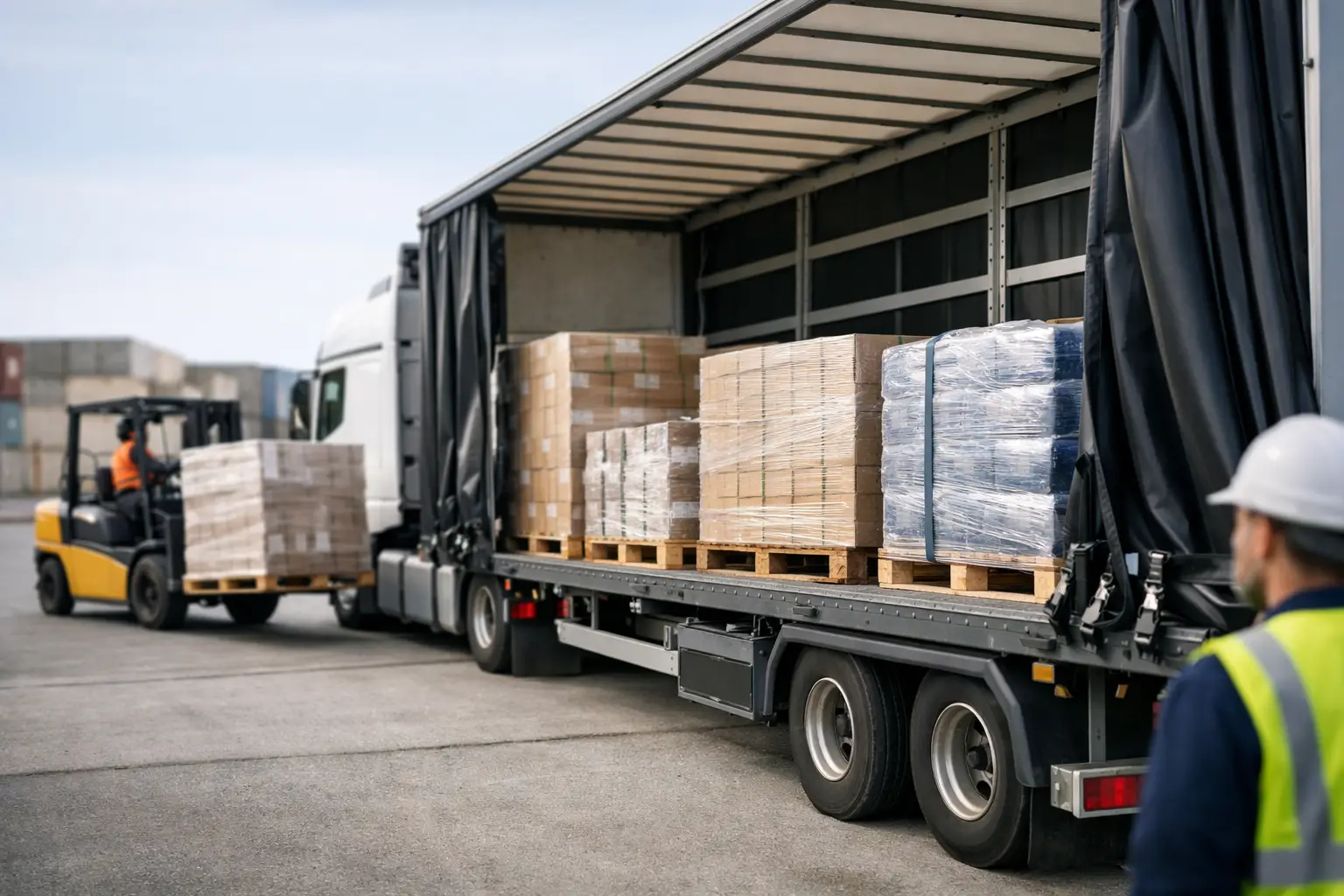
A tautliner can be loaded quickly and still be poorly planned. That is where damaged freight, unstable handling, restraint failures and driver injuries begin. This guide to tautliner load planning is built for the practical reality of Australian freight work: varied consignments, tight delivery windows, changing sites and drivers who need a safe, repeatable process.
Good planning starts before the forklift reaches the truck. It considers the load, the vehicle, the restraint method, the delivery sequence and the people doing the work. When those elements are organised together, loading becomes faster without taking shortcuts on safety.
Start tautliner load planning with the load
The freight determines the plan. Obtain accurate weights, dimensions, packaging details and any special handling requirements before allocating space in the body. A pallet count alone is not enough. Two loads with the same number of pallets can behave very differently if one includes dense machinery, loose cartons, tall pallets or unevenly distributed product.
Place the heaviest items low and as close as practical to the vehicle’s centreline. Weight needs to be distributed across the axles within the truck’s rated limits, not simply packed into whichever end of the body is empty. An overloaded axle affects vehicle handling, braking and compliance, even when the total payload appears acceptable.
Load shape matters as much as load weight. A high, narrow pallet has a different restraint requirement from a low, stable skid. Check whether pallets are sound, whether product overhangs the pallet footprint and whether the wrap, bands or packaging can withstand normal transport forces. Stretch wrap may hold product together, but it is not a substitute for a properly designed load restraint system.
Plan the load order before loading begins
The first pallet loaded is often the last pallet delivered. That sounds straightforward, but delivery sequence is regularly compromised when space is planned only for maximum cube utilisation. The result is unnecessary unloading, rushed rehandling and exposure to traffic or pedestrians at delivery sites.
Map the delivery order and identify freight that needs immediate access. Where practical, group consignments by drop and keep incompatible items separated. This is especially relevant for mixed freight runs, where one customer’s pallets may be heavy industrial product and the next may be light, damage-prone cartons.
There is a trade-off. A plan that gives every drop perfect access may leave unusable gaps, while a plan focused solely on maximum fill can create labour and safety issues later. The right balance depends on the route, unloading facilities, freight type and whether the driver is expected to manage deliveries alone.
Allow for forklift access and safe unloading direction. Do not create a situation where a driver or storeperson must climb, reach over freight or enter an unstable load space to remove restraints. If access cannot be made safe, revise the load plan before departure.
Check the truck body and restraint points
A tautliner’s curtains provide weather protection and load containment support. They are not automatically rated as the primary restraint for every load. The restraint plan must account for the body’s rated anchor points, tracks, gates, headboard, rear structure and the condition of all equipment.
Before loading, inspect the floor for damage, contamination or moisture that could reduce friction. Check that anchor points and track are free from distortion, corrosion and loose fittings. Confirm the curtains run correctly and that the roof, buckles and posts are in working order. A damaged curtain or compromised track should be addressed before the vehicle is loaded, not managed as an afterthought at the depot gate.
Restraint equipment must suit the freight and the vehicle. Using more straps does not necessarily make a load safer if their angle, position or anchor points are wrong. A restraint needs to control forward, rearward and sideways movement under braking, acceleration and cornering forces. It also needs to be applied in a way that does not crush, cut or damage the product.
For fleets operating curtain-sided trucks, an integrated restraint system can reduce the need for drivers to repeatedly climb into the body or work from exposed roadside positions. StrapNGo’s patented Australian-made system is designed to support safer, lower-labour load restraint in tautliners, with components selected for practical daily use.
Build restraint into the loading sequence
Do not leave all restraint work until the end of the load. Plan where restraints will sit as freight is positioned. This is particularly useful where the load is split into sections, where delivery drops require staged access, or where a full-length restraint cannot be applied without moving freight again.
Use positive restraint where required, and consider friction, blocking and containment as part of the overall arrangement. Dunnage, load bars, gates and suitable restraint systems can all have a role, but each must be compatible with the freight and correctly rated for its intended use. Improvised blocking or damaged timber creates risk rather than control.
Avoid restraint paths that pass over sharp edges without protection or where the equipment can loosen against smooth packaging. Make sure straps are not twisted and that hardware is fully engaged. If a load may settle during transport, account for that in the plan and require a check after the initial kilometres where safe and practical to do so.
A driver should be able to inspect restraint condition without having to guess what is happening behind a curtain. Clear loading patterns, accessible equipment and consistent placement make checks quicker and more reliable.
Give drivers a workable pre-departure check
A load plan only works if it can be checked in the real world. The driver needs enough time and safe access to complete a final inspection before leaving. Rushing this stage because the loading dock is under pressure transfers risk directly to the road.
A practical check should confirm that:
- freight is stable, correctly positioned and free from obvious damage;
- axle and payload limits have been considered;
- restraints are correctly tensioned, protected and attached to suitable points;
- curtains, rear doors, gates and buckles are secured; and
- loose equipment, packaging and dunnage have been removed or secured.
The check is not a paperwork exercise. It is the final opportunity to identify a pallet leaning against a curtain, an unsecured gap in the load, a strap routed incorrectly or a restraint point that has been missed. If something is not right, the vehicle should not leave until it is corrected.
Reduce manual handling risk in the plan
Load planning is also a driver safety issue. Manual restraint work can involve reaching above shoulder height, bending around pallets, climbing in and out of the truck body and working close to moving plant. Those tasks become more hazardous in wet conditions, poor lighting, confined yards and roadside delivery areas.
Look for ways to remove unnecessary handling rather than asking drivers to work faster. Position restraint equipment so it is accessible from a safe location. Use systems and tools that reduce climbing and overreaching. Establish clear separation between pedestrians and forklifts during loading, and make sure drivers know when it is safe to enter the loading area.
Consistency helps here. When every truck in a fleet uses a different restraint arrangement, drivers spend time adapting to each vehicle and errors become more likely. Standardising equipment, loading zones and inspection expectations improves productivity because the safe method becomes the familiar method.
Match the plan to the route and operating conditions
A metropolitan multi-drop run, a regional delivery route and an interstate linehaul should not automatically use the same loading approach. Consider road surface, expected braking and cornering demands, weather exposure at delivery points, the likelihood of load changes and the facilities available at each stop.
For example, freight that remains secure on a smooth depot-to-depot run may need more careful segregation and restraint when it will be progressively unloaded across uneven industrial sites. Likewise, a driver delivering alone may need an arrangement that allows safe restraint removal without entering the body beside unsecured freight.
Record recurring issues and use them to improve future plans. If a certain product regularly shifts, arrives damaged or takes too long to restrain, investigate the underlying arrangement. The answer may be a different pallet pattern, better packaging, revised equipment or a more suitable vehicle body setup.
Make safe loading the efficient way to work
The best tautliner load plan is not the one that looks neat at the depot. It is the one that keeps the freight stable, the vehicle compliant and the driver out of harm’s way from pickup through to the final delivery.
Set a clear standard, give drivers the right equipment and allow enough time to follow the process. When safe restraint is designed into the load rather than added at the end, fleets protect their people, their freight and their operating time.