
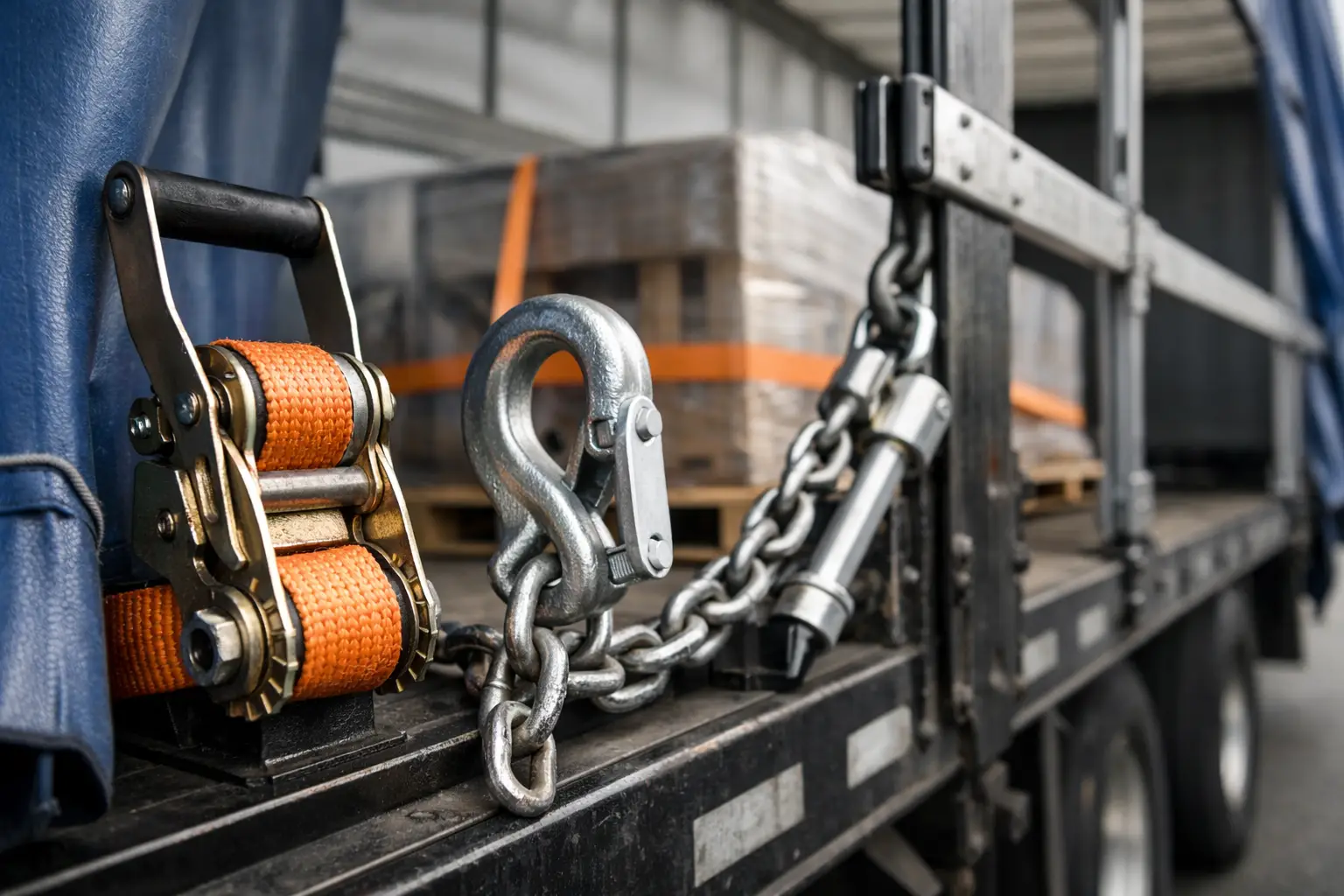
A restraint system can look sound during a depot walk-around and still create problems where it counts: beside a busy road, in poor weather, or late in a long shift. This load restraint hardware review focuses on the parts that determine whether a curtain-sided truck or tautliner can be secured safely, quickly and consistently.
For fleet operators, the question is not simply whether a strap holds freight in place. It is whether drivers can apply the system with minimal manual handling, whether the fittings suit the truck body and freight task, and whether the equipment stays dependable after repeated use. Hardware selection affects safety, loading time, vehicle uptime and the confidence drivers have in the job.
What a load restraint hardware review should cover
Load restraint is a system, not a collection of separate parts. Tracks, straps, anchors, ratchets, buckles, hooks and protection components must work together at their rated capacity and in the way they were intended to be used. A strong strap does not compensate for a poorly mounted track, worn fitting or incorrect anchor point.
A proper review starts with the actual operation. Consider the truck body, load types, delivery sequence, loading location and who is applying the restraint. A metropolitan multi-drop vehicle carrying palletised freight has different requirements from an interstate tautliner carrying mixed industrial loads. The right hardware depends on the work, not just the purchase price.
It should also account for the Australian load restraint requirements that apply to the vehicle and task. Equipment ratings, installation quality and use procedures all matter. Fleets should confirm that the proposed arrangement is suitable for their load restraint plan and operating conditions, rather than relying on a generic configuration.
Track systems: the foundation of the setup
For curtain-sided trucks, the track is often the component that receives the least attention until it becomes a problem. It carries the forces transferred through the restraint system and provides the positions where drivers can secure loads. Track selection and installation therefore deserve the same scrutiny as the straps themselves.
Check that the track profile is compatible with the fittings being used. A loose or mismatched fitting can be difficult to engage, may move under load, and wastes time during loading. The mounting arrangement is equally important. Tracks need to be installed into suitable structural areas of the truck body, with fixings and spacing appropriate to the system design.
Placement affects both safety and productivity. If anchor positions are too limited, drivers may have to work around freight, stretch to reach attachment points or use a less effective restraint angle. A well-planned track layout gives the operator usable anchor points along the body without creating unnecessary handling or access issues.
Inspect tracks regularly for distortion, damaged slots, corrosion, loose fasteners and contamination. Dust, pallet wrap and road grime can interfere with fittings. A track that appears serviceable from a distance may still be difficult to use when a driver is trying to secure a load quickly.
Fixed tracks versus flexible restraint positions
A fixed anchor point can work well where load dimensions and positions are highly consistent. The trade-off is reduced flexibility when the vehicle carries mixed freight. Track-based systems allow attachment positions to be selected to suit the load, which can improve restraint angles and make the truck body more versatile.
That flexibility must be matched by clear driver procedures. Operators need to know which fittings are approved for the track, how to confirm engagement and where restraint positions should be located for common load types.
Straps, buckles and tensioning hardware
Webbing condition is a straightforward safety check, but it needs to be done properly. Look for cuts, abrasion, fraying, heat damage, chemical contamination, worn stitching and damaged labels. If the rating or identification cannot be confirmed, the strap should not remain in service until it has been assessed under the fleet’s inspection process.
The tensioning method matters just as much. Ratchets offer controlled tension and are familiar across the industry, but they can add handling steps and require drivers to work close to the load. Over-tensioning can damage light freight or packaging, while insufficient tension can allow movement. Buckles and other locking components should release and lock cleanly, without forcing, sticking or visible deformation.
A practical system reduces the number of times a driver needs to climb, reach over freight or handle heavy components. This is where purpose-designed restraint hardware can deliver a real operational gain. When straps can be positioned and retrieved from a safer standing location, the process is easier to repeat across a full shift.
StrapNGo’s patented system is designed specifically for tautliners and curtain-sided trucks, using a track, bungee unit and extendable pole with hook to help drivers position and manage restraints with less physical effort. For operations where drivers are repeatedly securing loads from the side of the vehicle, reducing those awkward movements is a meaningful safety consideration.
Fittings and hooks: small parts with major consequences
Hooks, end fittings and track connectors are often the hardest-working components in the system. They are repeatedly loaded, released, dropped and exposed to road conditions. Their condition directly affects whether the restraint can be applied correctly.
Review fittings for cracks, bent gates, elongated holes, excessive wear, corrosion and poor engagement. A hook should sit fully in its intended attachment point. It should not be forced into a track, balanced on an edge or connected to an unapproved part of the body. Improvised connections create uncertainty in the load path and can expose the driver to a failure during tensioning or release.
Compatibility is critical. Hardware from different systems may look interchangeable but have different dimensions, ratings and engagement methods. Standardising approved components across a fleet makes inspections simpler, reduces incorrect substitutions and helps workshop teams keep the right spares on hand.
Driver safety is the real performance test
A restraint setup should be assessed in the position the driver actually works from. Can they attach and release it from ground level where possible? Is there a need to climb onto the vehicle, lean across the load or work between the truck and traffic? Can the hardware be handled with gloves on? These questions reveal more than a catalogue specification.
Roadside deliveries add pressure. Space may be limited, weather can reduce grip, and other vehicles may be moving nearby. Hardware that is quick to identify, simple to engage and reliable to release helps drivers keep their attention on the task instead of fighting with a damaged or poorly positioned component.
The safest system is not necessarily the one with the most parts. It is the one that gives the driver a repeatable method, uses suitable rated equipment and removes avoidable manual handling from the loading process.
Installation quality and fleet compatibility
Even well-designed hardware can underperform when installation is treated as an afterthought. Truck body builders and installers should understand the restraint system, the truck body structure and the intended operational use. Track alignment, fixing method, access around curtains and clearance from other equipment all need to be resolved before the truck returns to work.
For larger fleets, consistency across makes and body configurations is valuable. Where vehicles include Isuzu, Iveco, Fuso, Hino, Sitrak, UD Trucks, Mercedes-Benz or Scania, confirm that the selected system can be installed appropriately on each body type. The goal is not identical hardware at any cost, but a familiar, controlled restraint method across the fleet.
A pilot installation on one or two working vehicles can be worthwhile before a wider rollout. Involve experienced drivers, workshop staff and operations personnel. Their feedback will quickly show whether anchor positions are practical, whether the hardware suits the freight profile and whether loading time improves in real conditions.
Inspection and replacement need a clear routine
Hardware lasts longer when it is inspected before damage becomes a failure. Drivers should complete pre-use checks as part of their normal load restraint process, while workshop inspections should look more closely at tracks, fasteners, straps and fittings at scheduled intervals.
A useful routine records defects, removes damaged equipment from service and makes replacement parts readily available. Delaying a replacement because a vehicle is due back next week often leads to workarounds. Those workarounds are where risk increases.
Training should cover the reason for the system as well as the steps. When drivers understand load movement, restraint angles and the limits of each component, they are better placed to identify a problem before it becomes an incident.
The best restraint hardware earns its place by making the correct method the easiest method. Choose equipment that fits the truck body, the freight task and the people using it every day, then support it with sound installation, inspection and driver practice.