
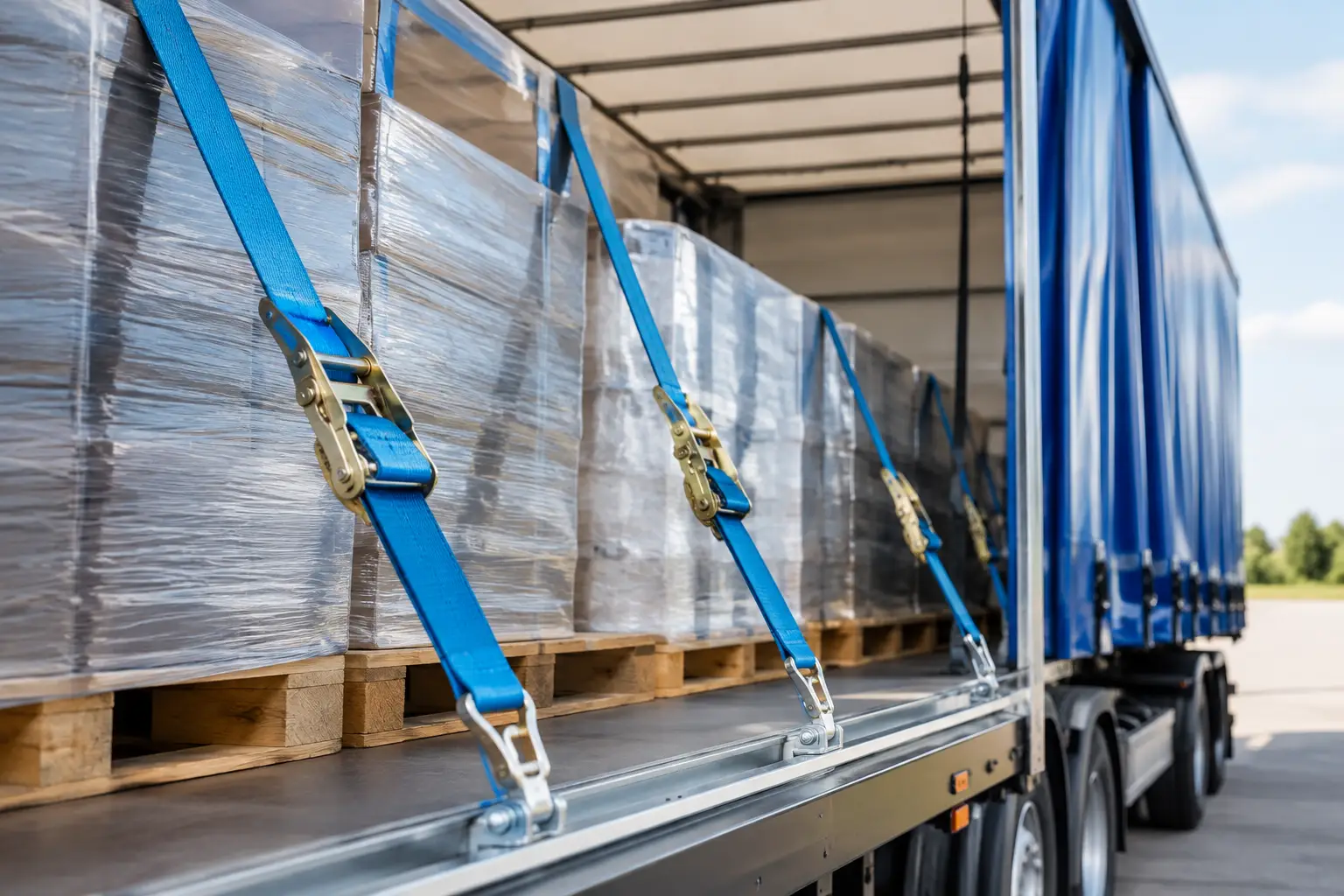
A curtain-sided truck can be loaded, shut up and ready to leave while the real risk is still sitting inside the body. Freight that can move during braking, cornering or uneven road conditions needs to be properly controlled before the truck rolls. Effective restraint systems protect the driver, the load, the vehicle and the people who unload it at the other end.
For tautliner operators, the job is not simply to put straps across a pallet and move on. The restraint method has to suit the freight, the load layout, the vehicle body and the task being performed. It also needs to be practical enough that drivers can use it correctly on every run, not just when there is extra time in the yard.
What a restraint system must do
A load restraint system prevents freight from shifting in the directions it is likely to travel in service: forwards under braking, rearwards under acceleration and sideways through corners or road camber. It must also account for the way the freight behaves. A stable, uniform palletised load presents a different challenge to mixed freight, awkward machinery, light cartons or a partial load with unused space in the body.
In a tautliner, curtains are generally weather protection, not a substitute for load restraint. The load still needs an appropriate internal method of restraint. This is where equipment selection and load planning matter. A system should work with the truck body rather than rely on a driver climbing, reaching or improvising around the load.
The strongest equipment is only one part of the outcome. Restraint capacity can be compromised by poor load distribution, damaged packaging, unsuitable anchor points, incorrect tensioning or gaps that allow freight to build momentum. The practical question is always the same: if the truck has to brake hard or take a sharp turn, what stops this load from moving?
Why conventional restraint methods can create risk
Traditional straps remain suitable for many freight tasks when they are correctly selected, rated and applied. However, conventional methods can introduce avoidable labour and exposure in curtain-sided operations. A driver may need to throw straps over freight, work around trailers and curtains, climb onto or lean across a load, or repeatedly reposition equipment between drops.
Those actions take time, particularly where there are multiple pallets, tight schedules or frequent deliveries. They can also expose drivers to manual handling strain and roadside hazards. Fatigue, rain, poor lighting and constrained delivery sites do not make the task easier.
This is not an argument for one restraint method in every application. It is an argument for choosing a setup that is safe, repeatable and realistic for the work being done. If a restraint process depends on excessive reaching, climbing or force, it is more likely to become inconsistent when pressure is on.
The hidden cost is often time at every stop
A few minutes spent securing a load may not sound significant. Across a fleet, repeated loading and unloading tasks add up quickly. So do the delays caused by misplaced straps, difficult access and the need to rework a load that was not planned properly.
A well-designed system can reduce handling steps while still providing effective control of the freight. That benefits drivers directly, but it also helps operations managers improve vehicle turnaround and create a more consistent loading process across the fleet.
Restraint systems designed for tautliners
Tautliners need restraint equipment that can be accessed and operated within the truck body without turning each load into a manual handling exercise. Track-based systems are designed to provide fixed restraint locations along the body, allowing the restraint to be positioned where the freight requires it.
A practical setup can include purpose-designed track, restraint units and a pole with hook for operating the system from a safer standing position. The benefit is not just speed. It is the ability to restrain freight without routinely throwing straps over a load or working at height.
StrapNGo is a patented, Australian-made load restraint system developed specifically for curtain-sided trucks and tautliners. Its arrangement is intended to support safe and secure freight restraint with minimal labour, using components such as track, a bungee unit and an extendable pole with hook. For fleet operators, the value is in making a safer method easier to use day after day.
Compatibility must still be confirmed for the individual truck body and operating task. The body structure, track installation, freight type and loading pattern all influence the right configuration. Established truck body builders and installers are well placed to assess how a system will fit into a vehicle build or fleet upgrade.
Start with the load, not the hardware
Before selecting equipment, examine what the truck carries most often. The best restraint system is one that matches real work, not an idealised loading scenario.
Consider freight weight, dimensions, pallet condition, packaging strength, centre of gravity and whether loads are stacked or mixed. Consider where deliveries are made too. A metropolitan dock with a forklift and level access creates different conditions to a regional site where the driver has limited room and variable ground conditions.
Load placement comes first. Heavy freight should be distributed appropriately and positioned to support safe axle loading and vehicle stability. Gaps should be minimised or managed so freight cannot move before contacting a restraint. Dunnage, blocking, load-rated gates or other methods may be necessary depending on the load. A restraint unit cannot correct a poorly packed body on its own.
It also matters whether the truck completes one full unload or several drops. Multi-drop work changes the load after every delivery. The restraint plan needs to be reviewed as the remaining freight is exposed and new gaps develop. A system that is quick to reposition can make this task more manageable, but the driver still needs to check the load at each stage.
A practical process for safer restraint
A reliable process is more useful than a complicated one. Before departure, drivers and loaders should be able to confirm that the freight is correctly positioned, the restraint equipment is suitable for the task and the vehicle is ready for the road.
A pre-departure check should cover four areas:
- The load is stable, distributed correctly and any gaps are managed.
- Restraint equipment is undamaged, correctly located and operated as intended.
- Tracks, anchor points and fittings show no sign of damage, distortion or loose fixings.
- Curtains and doors are secured, and the driver understands any checks required during the trip.
Equipment inspections should not be treated as a paperwork exercise. Webbing, hooks, buckles, tracks and mounting points all need regular attention. Damage, corrosion, cuts, deformation or worn components can affect performance. Remove suspect equipment from service and follow the manufacturer’s inspection and replacement requirements.
Training is equally important. A system is only safer when people understand how to use it, when it is suitable and where its limits are. New drivers, relief drivers and warehouse staff need the same clear process. Short, practical instruction at the vehicle is often more effective than a procedure that stays in a folder.
Safety and productivity should work together
Transport businesses are often forced to choose between doing a task quickly and doing it carefully. That is usually a sign the process needs improvement. The right restraint system reduces unnecessary handling without reducing the standard of restraint.
For owner-drivers, that can mean less strain over a long week and more confidence at difficult delivery sites. For fleet managers, it can mean a more consistent method across vehicles, fewer opportunities for unsafe shortcuts and better use of driver time. For truck body builders, it means being able to fit a practical restraint solution into a body designed for the customer’s actual freight task.
No restraint system removes the need for sound judgement. Freight changes, routes change and operating conditions change. But when safe equipment is built into the truck body and the loading process, drivers are better placed to make the right decision before the wheels start turning.
The most useful question at the next vehicle specification or fleet review is simple: can your drivers secure the load safely, quickly and consistently in the conditions they face every day? If the answer is not clear, the restraint process is worth revisiting before the next load leaves the yard.