
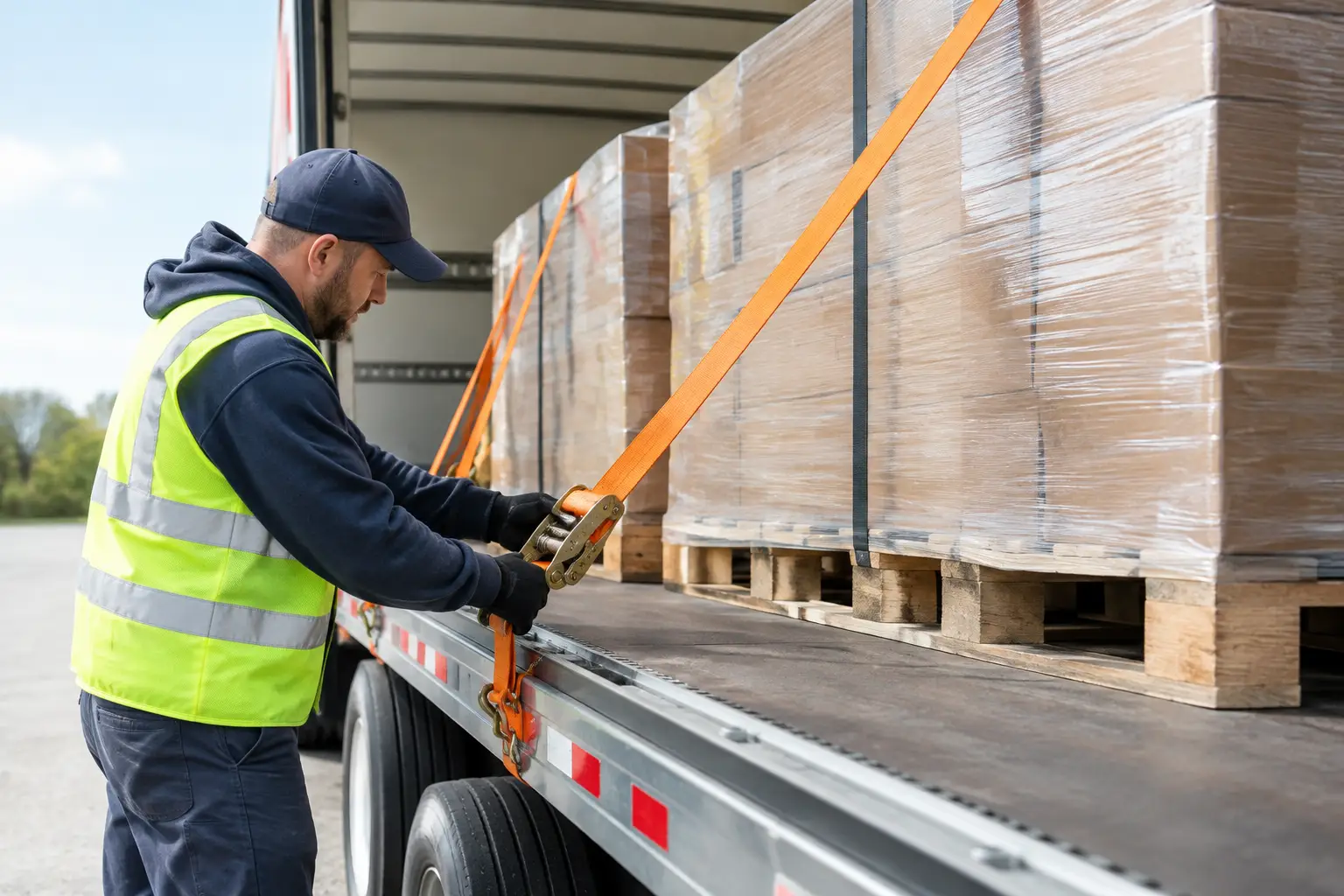
A curtain-sided truck can look secure while the load inside is doing very little to protect itself. Curtains provide weather protection and containment in many applications, but they are not automatically a load restraint system. That distinction sits at the centre of truck restraint standards and is where fleet operators, loaders and drivers need to be precise.
For Australian transport businesses, load restraint is not a paperwork exercise completed at dispatch. It is a practical requirement that affects every brake application, roundabout, uneven access road and roadside inspection. A sound restraint arrangement protects people around the vehicle, keeps freight stable and helps the operation move without unnecessary loading delays or manual handling exposure.
What truck restraint standards require in practice
The National Heavy Vehicle Regulator’s Load Restraint Guide 2025 provides practical direction for meeting loading performance requirements. The key question is simple: can the complete load restraint arrangement keep the load on the vehicle under the forces reasonably expected during transport?
Those forces are not limited to forward braking. Freight can move forward, rearward and sideways, and can lift or shift as a vehicle travels over changing road surfaces. The restraint method must account for the load, its packaging, its placement, the vehicle body and the restraint equipment working together.
This is why a strap rated in isolation does not prove a load is properly restrained. Its effectiveness depends on the anchor points, strap angle, tension, condition, contact with the load and whether the load itself can withstand the applied force. A well-maintained curtain, track or rail also has limits. Operators need to understand what each component is designed to do, rather than assuming the truck body will compensate for a weak restraint plan.
Loading performance is about the whole arrangement
Truck restraint standards are commonly discussed in terms of performance. In plain terms, the load must remain safely on the vehicle when the vehicle brakes, turns or encounters road movement. The appropriate arrangement changes with the freight task.
A palletised, shrink-wrapped load may behave very differently from stillages, machinery, building products, bagged goods or irregular freight. Friction between the load and deck may contribute to restraint, but it should not be guessed at. Wet surfaces, plastic pallets, damaged packaging, timber dunnage and vibration can all reduce the resistance available from friction.
The vehicle matters as well. A tautliner may have internal tracks, rated anchorages, headboards, gates or other structural features that form part of the restraint arrangement. Their condition, installation and intended use must be known. If a track has been damaged, modified or fitted without regard to the body structure, its presence alone is not enough.
The practical lesson is to assess each load as a system. Consider the weight and dimensions of the freight, where its centre of gravity sits, how it is packed, the available anchorages and the expected journey. A short metro run with consistent pallets may support a repeatable loading plan. Mixed freight on regional or interstate work often requires more careful selection and checking at every stop.
Curtain sides are not a substitute for restraint
Curtain-sided vehicles are efficient because they provide fast side access for forklifts and make multi-drop loading practical. That efficiency can create a false sense of security when the curtain is closed.
Unless a curtain and its associated body system are specifically engineered, identified and used as part of an approved load restraint arrangement, it should not be relied on to hold freight in place. Standard curtains can be damaged by a shifting pallet or heavy item, creating a serious risk to drivers, forklift operators and members of the public when the curtain is opened.
The correct approach is to restrain the freight before the curtain is closed. Where internal restraint is required, the equipment must be suitable for the load and correctly connected to appropriate anchorages. Drivers should also inspect the load position during the journey when safe to do so, particularly after heavy braking, rough roads or changes in the load.
Restraint equipment must suit the job
Webbing straps, chains, gates, blocking, nets and purpose-designed internal systems all have a place. The right choice depends on the freight and the truck body. There is no single restraint method that suits every load.
For tautliners, an internal strap system can reduce the need for drivers to climb, reach across freight or work beside live traffic. That is a significant operational benefit, but it does not remove the need to plan the load. Equipment must be correctly installed, used within its specifications and paired with suitable tracks, fittings and body structure.
Before a vehicle leaves, the operator should be able to answer four practical questions:
- Is the restraint method suitable for this load and this vehicle?
- Are the straps, tracks, fittings and anchorages in serviceable condition?
- Has the freight been positioned to avoid instability, excessive gaps or concentrated loads?
- Can the driver check, adjust and release the restraint without unnecessary risk?
These checks are not about slowing the job down. They prevent the rework, damage, injuries and delays that follow when a load shifts halfway through a run.
Manual handling is part of restraint compliance
A restraint arrangement may hold freight securely and still expose the driver to avoidable injury. Reaching over a load, handling heavy straps repeatedly, climbing on tyres or working from the roadside can create risks that need to be designed out where possible.
This is especially relevant for multi-drop distribution and drivers working alone. A system that requires less climbing, less reaching and fewer movements around the vehicle can improve consistency as well as safety. If restraint is difficult to apply, people are more likely to rush it, skip a check or use equipment in a way it was not intended to be used.
StrapNGo’s patented Australian-made system is designed for curtain-sided trucks and tautliners to support safer, lower-labour internal load restraint. As with any restraint equipment, compliance depends on the complete arrangement, correct installation, the suitability of the equipment for the freight and the applicable legal requirements.
Inspection and maintenance cannot be left to chance
Restraint equipment works hard. Webbing can be cut by sharp edges, contaminated by chemicals or weakened by abrasion. Hooks and fittings can deform. Tracks can become damaged, loose or blocked by debris. A defect that looks minor in the depot can become critical under braking force.
Build restraint checks into normal pre-start and loading procedures. Drivers need clear authority to remove damaged equipment from service, and workshops need a reliable process for inspection, replacement and repair. Keep compatible replacement parts on hand rather than improvising with mismatched fittings.
Training should cover more than how to tension a strap. Drivers, loaders and supervisors should understand why restraint angles matter, what an approved anchorage looks like, when a curtain cannot be relied upon and how different freight types behave. New starters need this knowledge before they are expected to load a vehicle on their own.
Make the safe method the fast method
The strongest load restraint process is the one people can repeat under normal freight pressure. That means setting loading plans for common freight, specifying the right equipment at vehicle build stage and giving drivers a method that does not rely on unnecessary climbing or awkward handling.
For fleet owners, truck restraint standards should influence procurement, body design, training and maintenance, not just roadside compliance preparation. For drivers, they provide a practical benchmark: if the load, equipment or setup does not look right, stop and correct it before the wheels turn.
Safe restraint is built before departure, one properly planned load at a time.