
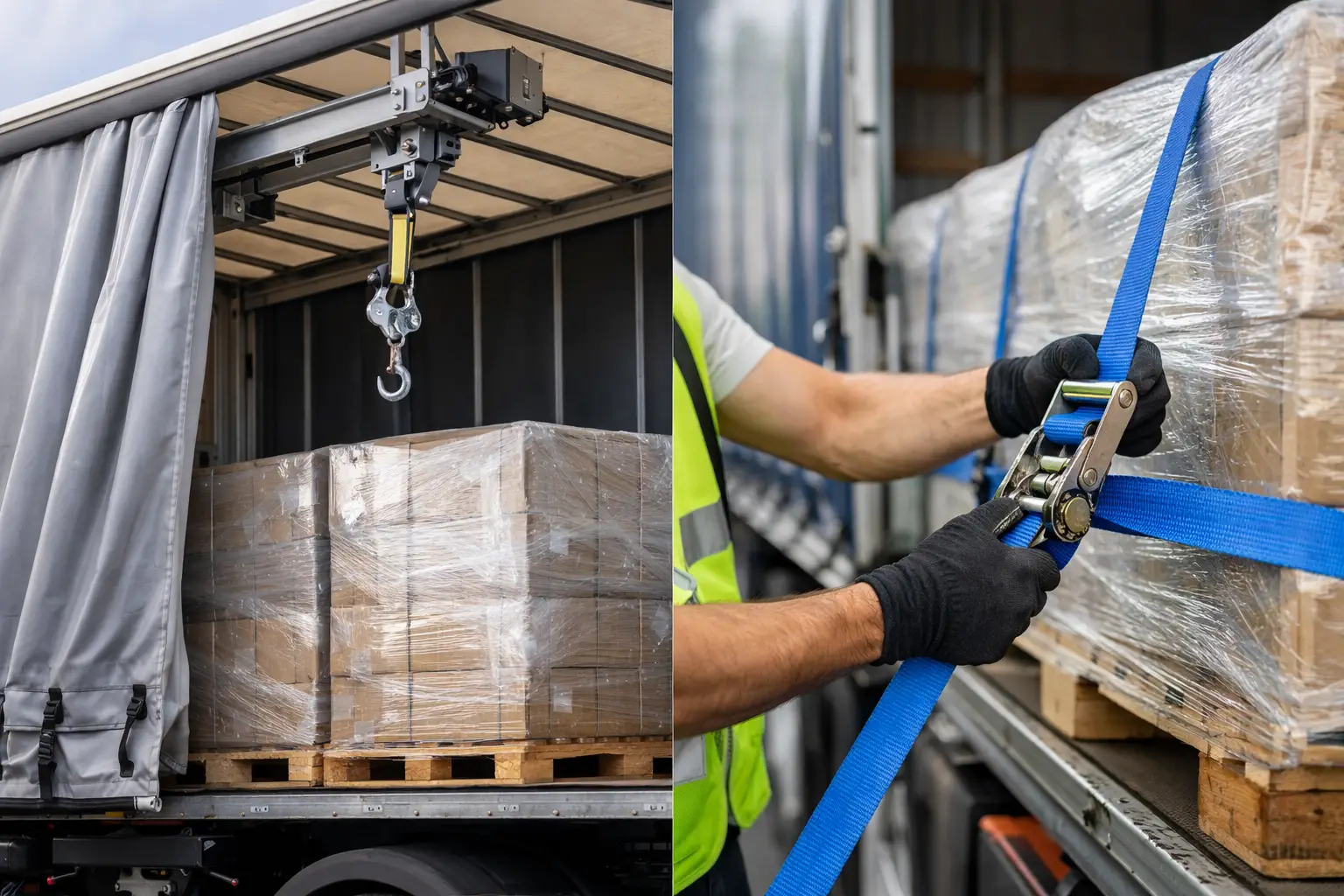
When a driver is climbing up, reaching in, or working freight from the roadside in poor weather, the curtain loader vs straps question stops being theoretical very quickly. It becomes a safety decision, a labour decision, and a productivity decision. For tautliners and curtain-sided trucks, the restraint method you choose affects every load, every stop, and every minute on the job.
Curtain loader vs straps in day-to-day transport
Traditional straps are familiar because they have been part of freight restraint for decades. Most operators know how they work, what they cost, and where they fit. But familiarity is not the same as efficiency, and it is not the same as lower risk.
A curtain loader system changes the way restraint is applied inside the body. Instead of relying on repeated manual throwing, reaching, tensioning and repositioning of straps across freight, the system is designed to make restraint quicker and less physically demanding. In practical terms, that means less manual handling and fewer awkward movements during loading and unloading.
For Australian fleets running metro, regional or interstate work, that difference matters. A system that saves a small amount of time per stop can add up quickly across multiple drops, multiple trucks and a full working week. More importantly, a system that reduces the need for drivers to work in exposed or awkward positions can have a direct effect on safety outcomes.
Where straps still make sense
There is no value pretending straps have no place. They do. Straps remain a workable option for many load types, especially in operations with lower freight variation, lighter loading schedules or truck bodies not yet set up for a curtain loader system.
They are also widely understood by drivers and workshops. Replacement parts are easy to source, and the process is familiar. For some smaller operators, that simplicity can look attractive at first glance.
The trade-off is labour. Straps depend heavily on the person doing the job. The process takes time, and consistency can vary from one driver to the next. Over a long shift, fatigue and repetition become part of the equation. So while straps can still be suitable in some applications, they often come with a higher manual workload and more exposure to avoidable handling risks.
Why the comparison usually comes down to safety
If you look at curtain loader vs straps purely on purchase price, you miss the real operating cost. Fleet operators know the bigger issue is what happens over months and years of use. How much driver effort is involved? How long does each restraint task take? How often are staff working in awkward positions? Where are the injury risks sitting in the job?
Traditional straps can require drivers to throw webbing, reach across loads, apply tension manually and repeat the process several times per load. That may not sound significant on paper, but repeated movement under time pressure is where strain and incident risk starts to build.
A curtain loader system is built to reduce that burden. It supports safer load restraint by bringing the process into a more controlled and repeatable method. That matters to drivers, but it also matters to operations managers and business owners carrying the cost of downtime, claims, lost hours and disrupted schedules.
Safety is not just about major incidents. It is also about reducing the smaller, constant risks that become normalised in transport. If a restraint method asks drivers to do more reaching, climbing, pulling and handling than necessary, that is a risk exposure whether the industry has become used to it or not.
Speed matters, but not at the expense of control
Productivity is usually the next point in the curtain loader vs straps discussion. Drivers do not get paid in theory. Fleets do not make margin on avoidable delays. Every extra minute spent restraining freight affects utilisation.
With straps, loading speed often depends on access, freight shape, weather, driver experience and how many times the load needs to be adjusted. On a straightforward job that might be manageable. On a multi-drop run with mixed freight, it can become a drag on the whole day.
A curtain loader system helps streamline that part of the task. It gives operators a more consistent process, which is often where the time saving really sits. The result is not just faster restraint in ideal conditions. It is more predictable restraint across ordinary working conditions, including the messy ones.
That consistency is valuable for businesses trying to keep trucks moving without cutting corners on load security. The best restraint method is not the one that is fastest only when everything goes right. It is the one that helps the job stay controlled when the day gets busy.
Load type changes the answer
Not every load behaves the same, and this is where a one-size-fits-all opinion falls apart. Some freight profiles can still work reasonably well with conventional straps, particularly where the load is uniform, stable and easy to access. Other freight types put far more pressure on the restraint process.
Mixed palletised freight, variable heights, frequent drop sequences and high-volume handling all increase the value of a system that reduces repeated manual effort. In these settings, the difference between curtain loader vs straps is not minor. It can affect load time, unloading flow and the number of physical actions required at each stop.
Operators should also think about the environment the truck is working in. Urban delivery, roadside unloading and high-frequency route work all make safer, lower-labour restraint more commercially relevant. If drivers are repeatedly opening curtains and securing loads in tight or exposed areas, every step that can be simplified has value.
The hidden cost of sticking with straps
Many businesses stay with straps because they are already part of the fleet. That is understandable. Existing methods often remain in place simply because changing them takes planning. But the status quo has a cost.
The cost is measured in loading delays, manual handling fatigue, driver frustration and inconsistent restraint practice. It is measured in the extra effort required at every stop. It is also measured in recruitment and retention pressure, because good drivers notice when a job is harder than it needs to be.
This is especially relevant in a market where operators need practical ways to improve conditions without reducing output. A lower-labour restraint system does not just support compliance and safety. It can make the truck easier to work with day after day.
That matters in real transport businesses. Practical improvements are the ones that get used, and the ones that keep delivering value after the first week.
Curtain loader vs straps for fleet decision-makers
For procurement teams, workshop managers and fleet owners, the right comparison is not old method versus new method. It is whether the restraint system suits the operation and improves the commercial outcome.
A curtain loader system is usually the stronger option where businesses want to reduce manual handling, improve turnaround time and support a safer standard of work across multiple drivers and vehicles. It is particularly relevant for fleets running tautliners and curtain-siders at scale, where small process improvements multiply quickly.
Straps may still remain part of some operations, especially in transitional fleets or specific load applications. But if the business priority is lower labour and safer freight restraint, straps alone are often not the strongest long-term answer.
This is where a patented, Australian-made system built specifically for tautliners becomes more than a product feature. It becomes an operational tool. One mention is enough here: that is the reason systems like StrapNGo have gained traction with fleets, body builders and owner-drivers who need a practical solution rather than another piece of equipment that looks good in a brochure.
So which works better?
If the question is simply whether straps can restrain a load, the answer is yes, in many cases they can. If the real question is which method better supports safety, reduces labour and improves loading productivity in a modern transport operation, a curtain loader system has the stronger case.
That does not mean every truck changes overnight or every load is identical. It means the direction is clear. Where operators want less reaching, less manual effort, more repeatability and a safer way to secure freight, the curtain loader vs straps decision usually leans one way.
The best restraint method is the one that helps drivers finish the day with the load secure, the schedule intact and less physical wear from doing the same hard task over and over.