
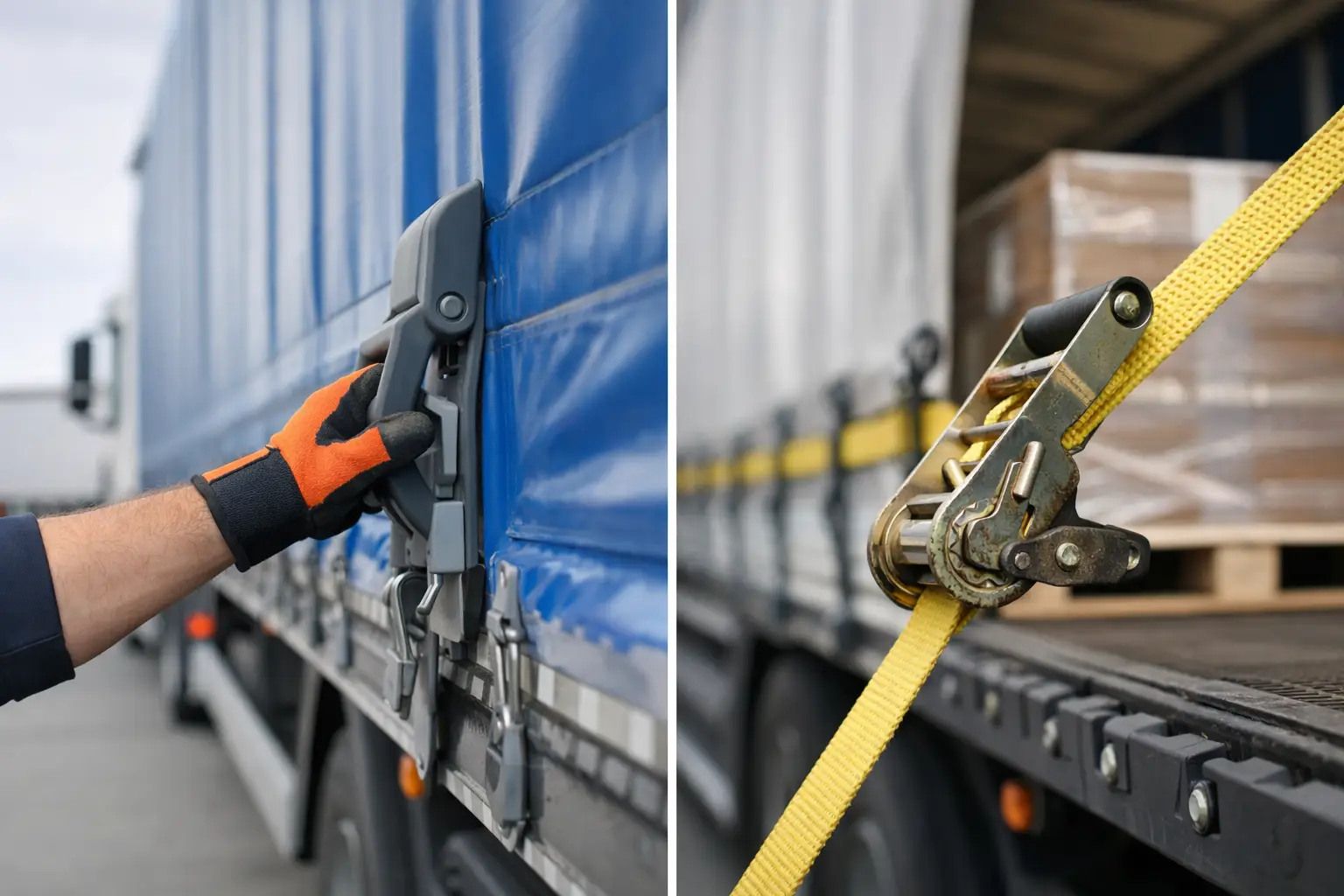
A driver climbing onto a trailer deck to throw, tension and release ratchet straps is not just completing another loading task. They are working around traffic, weather, uneven ground and freight that may shift as tension comes off. That is the practical issue behind curtain systems vs ratchet straps for Australian tautliner operators: both can restrain freight, but they place very different demands on the driver and the operation.
Ratchet straps remain common for good reason. They are familiar, flexible and suitable for many load types when selected, positioned and tensioned correctly. But when the same vehicle completes multiple drops each day, the labour and manual handling involved can become a real safety and productivity cost. A purpose-designed curtain-side restraint system can reduce that burden, provided it suits the freight, trailer body and restraint requirements.
Curtain systems vs ratchet straps: the real difference
The first point is simple: a curtain is not, by itself, load restraint. A curtain-sided body provides weather protection and side access. Freight still needs to be restrained with equipment and methods appropriate to the load, vehicle and journey.
Traditional ratchet straps are generally handled individually. The driver retrieves each strap, places it over or around the freight, connects it to a suitable anchor point, tensions it with a ratchet, and reverses the process at delivery. Depending on the job, they may need to work from the trailer deck or manage straps from both sides of the vehicle.
A curtain-side restraint system is integrated into the truck body. The restraint components are positioned in a track or fixed arrangement so the operator can deploy and secure them from a safer working position, often from ground level. The goal is not to eliminate sound load restraint practice. It is to make repeated restraint tasks less physically demanding and more consistent.
That distinction matters. The choice is not between doing restraint properly and doing it quickly. The right system should support both.
Driver safety starts with the loading routine
Manual ratchet strap work creates several familiar exposure points. Drivers may climb up and down from the deck, reach over awkward loads, pull heavy webbing, and apply significant force to ratchet mechanisms. These actions are repeated across a shift, often before sunrise, in rain, on a busy site or beside a live roadway.
The risk is not limited to a fall. Overreaching, shoulder strain, hand injuries, pinch points and slips while handling loose straps are all part of the picture. Releasing a highly tensioned ratchet also requires care, particularly if the load has settled or moved during transport.
An integrated system can reduce the need for drivers to climb, throw straps across a load or repeatedly handle ratchet hardware. That is particularly valuable for fleets working with high-frequency metropolitan deliveries, mixed freight runs and multi-drop distribution. Less work at height and less repetitive strain is a practical safety outcome, not a marketing line.
It does not remove the need for training. Drivers still need to assess the load, understand restraint forces, inspect equipment, use the system as designed and check freight at the required intervals. A safer system is one that makes correct behaviour easier, rather than relying on drivers to take shortcuts when the day gets busy.
Loading speed is about more than minutes
A ratchet strap may only take a few minutes to fit. On one load, that may not matter. Across a fleet, several straps fitted and removed at every stop can add up to considerable labour time.
The time cost also includes handling and storing loose webbing, untangling straps, finding damaged gear, repositioning straps around pallets and clearing the work area before the curtains are closed. At delivery, the driver repeats the process before freight can be accessed.
Integrated curtain-side systems are designed to reduce those repeated steps. When restraint equipment is stored in a known position on the body and can be deployed with a controlled process, loading crews can work with a more predictable routine. This can help keep vehicles moving through warehouses and customer sites without rushing the driver.
However, speed should never be assessed in isolation. If a system is poorly matched to the load, forces drivers to improvise, or makes inspection difficult, any time saved at the dock can be lost through rework, delays or an unsafe load. The best productivity gains come from a system that fits the freight profile and the daily operating pattern.
Flexibility still favours ratchet straps in some work
Ratchet straps have a clear advantage where freight varies significantly from one job to the next. Odd-shaped plant, machinery, bundled products, long items and irregular loads can require highly adaptable restraint points and configurations. In these cases, standard ratchet straps, chains or other purpose-selected restraint equipment may remain the right answer.
They are also useful as supplementary restraint. An integrated system does not mean every load receives the same treatment. Different freight may require blocking, gates, rated nets, dunnage, direct restraint or additional tie-downs. Load restraint must always be selected for the actual load and the forces it can experience under braking, cornering and acceleration.
Curtain-side systems are strongest where the work is repetitive and the freight is reasonably consistent. Palletised distribution, packaged goods and regular transport lanes are common examples. When operators know the load dimensions, loading sequence and restraint requirements, a fitted system can deliver a more reliable process than loose equipment handled differently by each driver.
Compliance needs a system, not a shortcut
No restraint method should be chosen solely because it looks faster or easier. Australian operators need to meet applicable load restraint obligations, vehicle requirements, workplace safety duties and site rules. The freight must be restrained so it remains secure throughout normal driving and foreseeable emergency manoeuvres.
For ratchet straps, that means using appropriately rated equipment, suitable anchor points, correct angles and enough restraint capacity for the load. Webbing, hooks, ratchets and anchor points require regular inspection. Cuts, abrasion, corrosion, distorted hooks and damaged ratchets are not minor defects to ignore.
For an integrated system, compliance depends on correct specification and installation. The trailer body, track, mounting points and associated components must suit the application. Installation should be completed by experienced truck body builders or authorised installers who understand the vehicle body and the intended restraint method.
Documented procedures are equally important. Drivers should know which loads the system is intended to secure, when additional restraint is required, how to inspect components and what to do if a part is damaged. A consistent process protects the driver, the load and the business when work changes hands between shifts.
Maintenance and lifecycle cost
Loose ratchet straps are relatively inexpensive to buy, but their operational cost is not limited to the purchase price. They are exposed to abrasion, dirt, water, forklift contact and incorrect storage. Straps can disappear from vehicles, become tangled or be left at a delivery site. Replacement costs and downtime are often spread across the operation, making them easy to underestimate.
An installed restraint system has a higher upfront commitment because it becomes part of the truck body. In return, components have defined storage positions and are less likely to be dragged across the ground or misplaced. For fleets with regular work, reduced handling time and fewer manual handling exposures can justify the investment over the life of the vehicle.
The decision should account for the vehicle’s planned service life, the number of loads and drops completed each week, likely driver turnover and the cost of downtime. A single owner-driver doing variable work may reach a different answer from a distribution fleet operating several curtain-siders on fixed runs.
Choosing the right approach for your fleet
Start with the freight, not the hardware. Look at its weight, shape, packaging, pallet pattern and whether loads are consistent across each route. Then consider where drivers work. A controlled depot is very different from roadside delivery, regional yards and customer sites with limited space or uneven surfaces.
Next, map the loading process honestly. Count how many times drivers climb, throw straps, operate ratchets, walk around the vehicle and reopen curtains during a typical shift. Those are the tasks where safety risk and lost time often sit. Speak with drivers as well as managers – they will quickly identify where the current process creates delays or strain.
For regular tautliner work, an Australian-made, patented system such as StrapNGo can provide a practical alternative to repeated manual ratchet strap handling. It is designed for curtain-sided trucks and tautliners, with supporting components that help drivers deploy restraint equipment with minimal labour.
Ratchet straps will continue to have a place in transport. The stronger question is whether they should remain the primary day-to-day method for every load on every curtain-sider. When the work is repetitive, a properly specified curtain-side restraint system can give drivers a safer routine and give the fleet more productive hours on the road.