
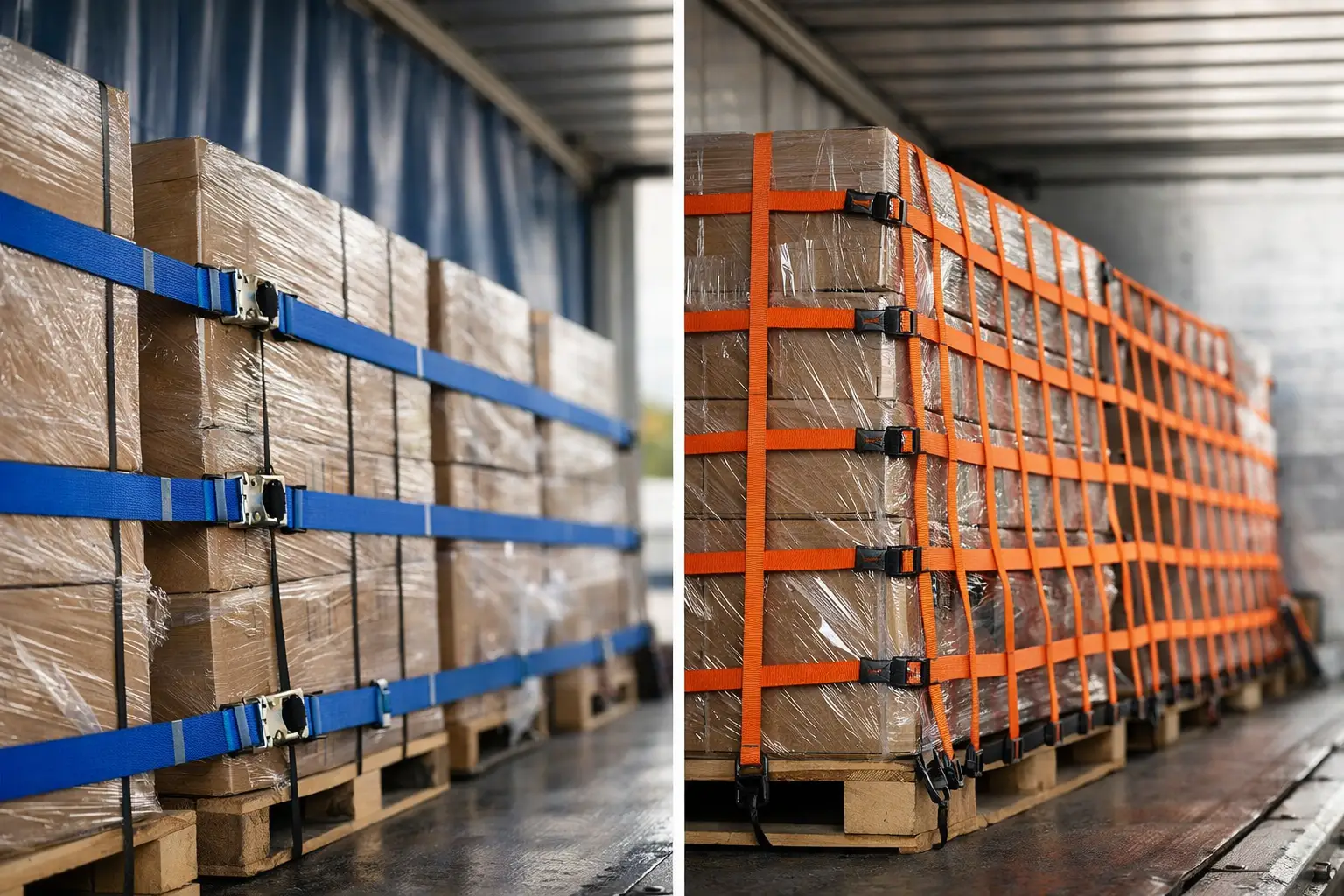
A curtain-sided truck can make loading quick, but the curtain is not a load restraint. When a pallet shifts in a hard brake, on a roundabout or during an evasive manoeuvre, the restraint system inside the body is what keeps the load controlled. That is the real question in tautliner restraints vs load nets: which method suits the freight, the vehicle and the way your operation works?
For Australian fleets, this is not just a purchasing decision. It affects driver safety, manual handling exposure, loading time, vehicle utilisation and the ability to demonstrate that loads are properly restrained. The right answer is rarely the cheapest item in the catalogue. It is the system that can be applied correctly, consistently and safely on every run.
What each restraint method is designed to do
Load nets are flexible netted assemblies placed over, around or across freight. They are commonly used to retain loose, irregular or lightweight items, particularly where a single rigid contact point would not cover the load properly. A correctly rated and fitted net can spread restraint forces across a broader area than an individual strap.
Tautliner restraint systems generally use purpose-designed tracks, straps and fittings within the truck body to restrain pallets or other unitised freight. The arrangement is intended to create positive restraint against movement in the relevant directions, with the restraint positioned to suit the load and vehicle.
Neither option is automatically compliant simply because it is fitted. Restraint capacity, anchor point ratings, load shape, friction, blocking, the direction of likely movement and the manufacturer’s instructions all matter. The load must be assessed as a complete system, not as a net or strap considered in isolation.
Tautliner restraints vs load nets in day-to-day use
The practical difference is often clearest at the loading dock. A load net can be versatile, but it usually needs to be lifted, unfolded, positioned and tensioned by hand. On a high deck or around tall freight, that can mean climbing, reaching or working from an exposed position. If the net is awkward to handle, a driver may be tempted to take shortcuts when time is tight.
A fixed tautliner restraint system can reduce those steps. Tracks are installed in the body, while restraint components are stored ready for use and positioned where needed. A system designed for pole operation allows the driver to place and retrieve the restraint from ground level rather than climbing on tyres, trailer rails or the load itself.
That difference matters over a full shift. Saving a few minutes per drop can improve turnaround time, but the bigger benefit is reducing repeated bending, stretching and climbing. Manual handling risk is cumulative. A process that looks manageable once can become a problem after ten or twenty deliveries.
Where load nets make sense
Load nets remain a useful option when freight is loose, unevenly shaped or difficult to contain with conventional straps. Examples can include bagged product, awkward mixed freight, light bulky items or a load that needs broad containment rather than precise restraint at a pallet face.
They can also be practical when a vehicle carries varied loads and no fixed restraint layout will suit every job. However, a net needs to be the right size, rating and configuration for the application. A net thrown over freight without suitable anchor points, tension and consideration of likely load movement is not a reliable solution.
Nets also need regular inspection. Damaged webbing, stretched mesh, worn hooks and distorted fittings can reduce performance. Because the load can conceal parts of the net, drivers need a clear pre-departure check rather than assuming the system is secure once the curtain is closed.
Where fixed tautliner restraints are stronger
For regular palletised freight, fixed tautliner restraints provide a repeatable process. The driver can use the same approved restraint positions, follow the same sequence and achieve a consistent outcome across vehicles. That consistency is valuable for fleet managers trying to improve safety standards across multiple depots, drivers and routes.
A track-based system is particularly suited to operations where load dimensions are reasonably predictable, including general freight, distribution work, industrial transport and interstate runs. It can be adjusted along the body to accommodate different pallet positions without relying on the curtain as part of the restraint arrangement.
StrapNGo’s patented Australian-made system is designed around this operating reality: secure freight with minimal labour and reduce the need for drivers to climb or work in unsafe positions. When specified and installed correctly, a purpose-built system gives fleets a practical method that drivers can use day after day.
Safety is more than restraint capacity
A restraint method may have sufficient rated capacity on paper and still create unnecessary risk during loading. Fleet operators should assess how the driver reaches the restraint, how it is tensioned, and whether the task can be completed without working at height or leaning over unstable freight.
This is where load nets can present a trade-off. Their flexibility is useful, but large nets can be physically demanding to deploy. Wet weather, wind, limited room at a customer site and a high load deck can make an otherwise simple task harder. If two people are needed to handle the net safely, that affects labour planning and delivery timing.
Fixed restraints can reduce the physical effort involved, but they require proper installation and driver training. Tracks must be fitted to a suitable truck body structure. Components must be compatible, rated and maintained. Drivers need to know when the system is appropriate and when unusual freight requires additional measures, such as blocking, dunnage or a different restraint method.
The aim is not to eliminate driver judgement. It is to give drivers a safer, repeatable system for the jobs they perform most often.
Consider the freight before choosing the system
The best restraint method starts with the freight profile. Palletised cartons, drums, wrapped goods and consistently sized loads generally favour a track and strap arrangement because restraint points can be positioned accurately. Dense loads with a high centre of gravity may require careful restraint planning regardless of which system is used.
Mixed consignments need more thought. A tautliner may leave the depot with full pallets, then complete multi-drop deliveries where the remaining freight no longer fills the body. As load distribution changes, restraint needs to change with it. An adjustable system helps, but only if drivers can reposition it quickly and safely.
For loose or irregular loads, a net may provide better coverage. Even then, consider whether the net is restraining the load against movement or merely covering it. If the load can slide beneath the net or the anchor points are unsuitable, broader coverage does not equal better control.
The vehicle also matters. Body construction, track location, available anchor points, deck height and loading method should all be reviewed before committing to a setup. A system that works well on one curtain-sider may not transfer directly to another body design.
Productivity comes from repeatability
Fast loading is not simply about using fewer components. It is about removing avoidable steps and preventing rework. If a driver has to untangle a net, find suitable anchorage, reposition it several times and then climb to check the far side, the task can quickly consume valuable time.
A well-designed tautliner restraint process is easier to standardise. Drivers know where the components are, how to apply them and how to inspect them. Workshop teams can inspect common parts across the fleet, while operations managers can build clear loading procedures around known vehicle configurations.
That does not mean every truck needs identical restraint equipment. A mixed fleet may reasonably use fixed restraints for recurring palletised routes and load nets for specialised or irregular work. The commercial benefit comes from matching each vehicle to the freight it carries most, rather than forcing one method onto every task.
Questions to ask before buying
Before selecting load nets or a tautliner restraint system, assess the job honestly. How often does the vehicle carry palletised freight? Does the driver need to climb to fit the restraint? Are loads consistent from run to run? Can the system be inspected quickly? Is it compatible with the truck body and rated anchor points? And can drivers apply it correctly under normal delivery pressure?
Also look beyond the initial purchase price. A lower-cost restraint that takes longer to fit, requires extra labour or contributes to manual handling incidents can cost more over its service life. Durability, parts availability, installation quality and local support are operational considerations, not extras.
The right restraint method is the one your drivers will use correctly every time. For regular tautliner work, that usually means a purpose-built, track-based system that keeps restraint accessible, secure and off the driver’s climbing path. For irregular freight, a properly selected load net may still be the right tool. Start with the load, design the process around safe handling, and give drivers equipment that makes the safe choice the practical choice.