
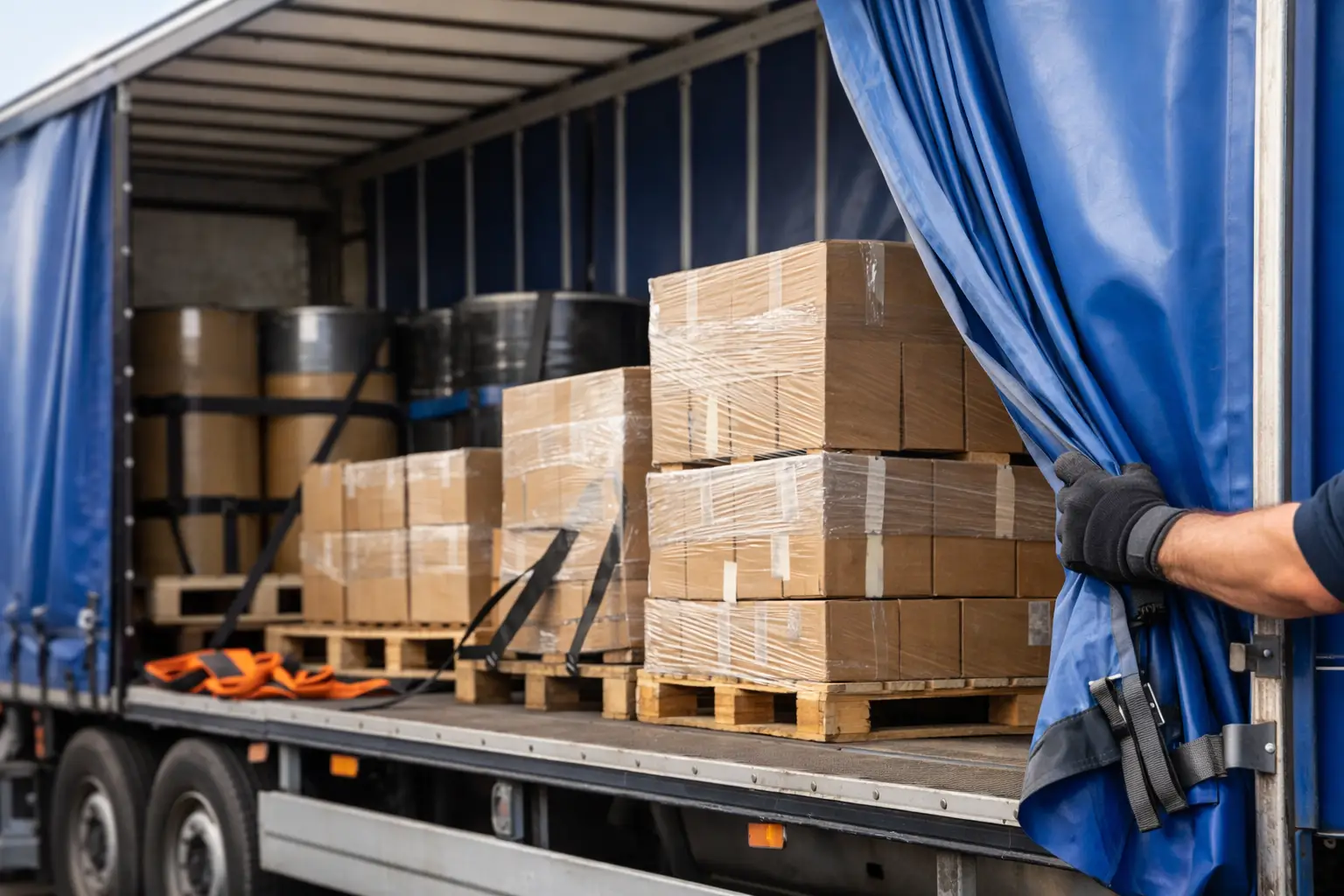
A curtain-sided truck can look fully enclosed once the buckles are fastened, but curtains restrain freight only in specific, engineered circumstances. For most tautliners, the curtains provide weather protection, access and containment. They are not a substitute for a correctly selected and applied internal load restraint system.
That distinction matters every time a driver brakes hard, takes a roundabout, avoids an obstacle or travels on uneven roads. Freight moves under force. If it is not restrained to suit the load, the vehicle and the journey, the result can be damaged product, unstable handling, curtain damage and serious risk to drivers, loaders and people working beside the truck.
Why curtains do not automatically restrain freight
A standard truck curtain is designed to open and close efficiently while protecting freight from the elements. It is not automatically rated to withstand the forces created by a shifting pallet, stillage, IBC or machinery load. Buckles, roof rails and curtain fabric may help keep a load enclosed, but enclosure and restraint are different jobs.
Some curtain-sided bodies are purpose-built and certified to provide a defined level of load restraint. Where that is the case, the vehicle manufacturer or body builder should provide clear documentation stating the system’s capability, operating limits and required loading arrangement. The rating may depend on the type of load, its height, the use of rear doors, internal restraint equipment, curtain tension and other body features.
The practical rule is straightforward: do not assume a curtain is load restraint because it looks substantial or because a similar truck in the fleet uses one. Check the body documentation, understand its limits and make sure the actual load matches the approved configuration.
What freight must be restrained against
A load restraint plan needs to account for movement in every direction. Under normal transport conditions, freight can move forward under braking, sideways during cornering, rearward under acceleration and vertically over rough surfaces. A restraint method that appears adequate when the truck is parked may not be adequate once the vehicle is moving.
For Australian operators, load restraint must be managed in line with applicable road transport requirements, workplace safety obligations and the recognised performance expectations for the task. The vehicle, load, restraint equipment and loading method all work together. There is no single strap pattern that suits every job.
Palletised freight is a common example. A tightly packed load may gain support from the headboard, side structure and adjacent pallets, but gaps can develop as freight is unloaded across a run. The remaining pallets may then need a different restraint arrangement. A load that was stable at the depot can become exposed after the first few drops.
This is why drivers need a system they can adjust quickly and safely throughout the day, rather than relying on curtains to hold freight in place.
Internal restraint is the working control
On a tautliner, internal restraint gives the operator direct control over the load. It can be positioned to suit changing freight, used to manage gaps and applied without treating the curtain as a structural barrier. Depending on the freight and body configuration, this may involve rated straps, load bars, nets, dunnage, blocking or a purpose-designed restraint system.
The right option depends on the task. Heavy machinery, mixed freight, light cartons and fully wrapped pallet loads each behave differently. A restraint system must also connect to suitable rated anchor points or tracks. Good straps attached to unsuitable points do not create a compliant outcome.
The best systems reduce the amount of unnecessary climbing, stretching and working at height. That is not just a convenience. Manual handling and access risks are a daily concern for drivers working around trailers, especially when loading in busy yards, on uneven ground or at roadside delivery locations.
Speed matters, but safe access comes first
Traditional restraint methods can require drivers to move repeatedly between sides of the vehicle, reach across freight or climb to retrieve and tension straps. These actions add time to every load and expose drivers to avoidable risk.
A track-mounted restraint arrangement keeps the equipment where it is needed and supports a more repeatable loading process. When combined with a suitable extendable pole and hook, drivers can position or retrieve restraints with less climbing and less need to reach across the load space.
This is the operational value of a system such as StrapNGo: its patented, Australian-made design is intended to secure freight in tautliners with minimal labour while improving driver safety and loading productivity. The objective is not to rush the restraint process. It is to remove wasted movement and make the safe method easier to apply on every run.
A practical loading check before the curtains close
A driver should be able to assess the load before departure without relying on guesswork. Start by confirming the freight is distributed sensibly across the deck and within axle and mass limits. Then consider where the load can move, particularly at the front, rear and any open spaces between freight.
Check that restraint equipment is suitable for the load and is connected to rated, serviceable anchor points. Straps should not be twisted, cut, badly worn or routed over sharp edges without appropriate protection. They must be tensioned correctly and positioned so they control the likely movement of the freight, not simply make the load look tied down.
Before closing the curtains, inspect the body itself. Damaged buckles, torn fabric, loose tracks, bent rails and compromised anchor points need attention. A curtain body in poor condition can create both a weatherproofing issue and a safety issue, even when the internal restraint has been applied correctly.
After the curtains are closed, complete the required walk-around. The outside of the vehicle can reveal a problem inside, such as an unusual bulge, uneven curtain tension or damaged hardware. If a curtain is carrying visible load pressure, stop and reassess the restraint arrangement. The curtain should not be the last line holding the freight in place.
The risk changes as multi-drop loads change
Multi-drop work is where restraint discipline is often tested. Each time pallets are removed, the balance and containment of the remaining freight changes. What was blocked by adjacent product at the start of the day may now have room to slide, tip or fall.
Drivers need enough time and the right equipment to re-secure the load after each drop where required. Fleet procedures should make this expectation clear. Pressuring drivers to leave quickly while expecting them to maintain a safe load creates the wrong trade-off.
Operations managers can help by designing loading patterns that account for delivery sequence. Where practical, place freight so that later drops do not leave large unsupported gaps. Give drivers a simple process for identifying when restraint must be repositioned, and ensure replacement straps and hardware are readily available.
Choosing a system for a working fleet
For fleet owners and body builders, the decision is about more than purchasing straps. The restraint method needs to suit the truck body, the common freight profile and the way drivers actually load and unload. A system that is technically capable but awkward to use will be inconsistently applied.
Look for equipment with clear ratings, durable materials and a fit-for-purpose installation. Confirm compatibility with the truck body and arrange installation through an experienced truck body builder or installer. Training should cover both the equipment and the loading logic behind it, including when curtains have a documented restraint role and when they do not.
It also pays to involve drivers early. They can identify where current methods cost time, create awkward reaching or fail during real multi-drop work. Their feedback can turn a restraint upgrade from a workshop project into a safer daily operating standard.
Curtains have an essential place on a tautliner, but their job should be clearly understood. Treat them as curtains unless the body is specifically engineered, rated and documented otherwise. Give drivers internal restraint they can use quickly, correctly and safely, and the load has a far better chance of arriving exactly where it was placed.