
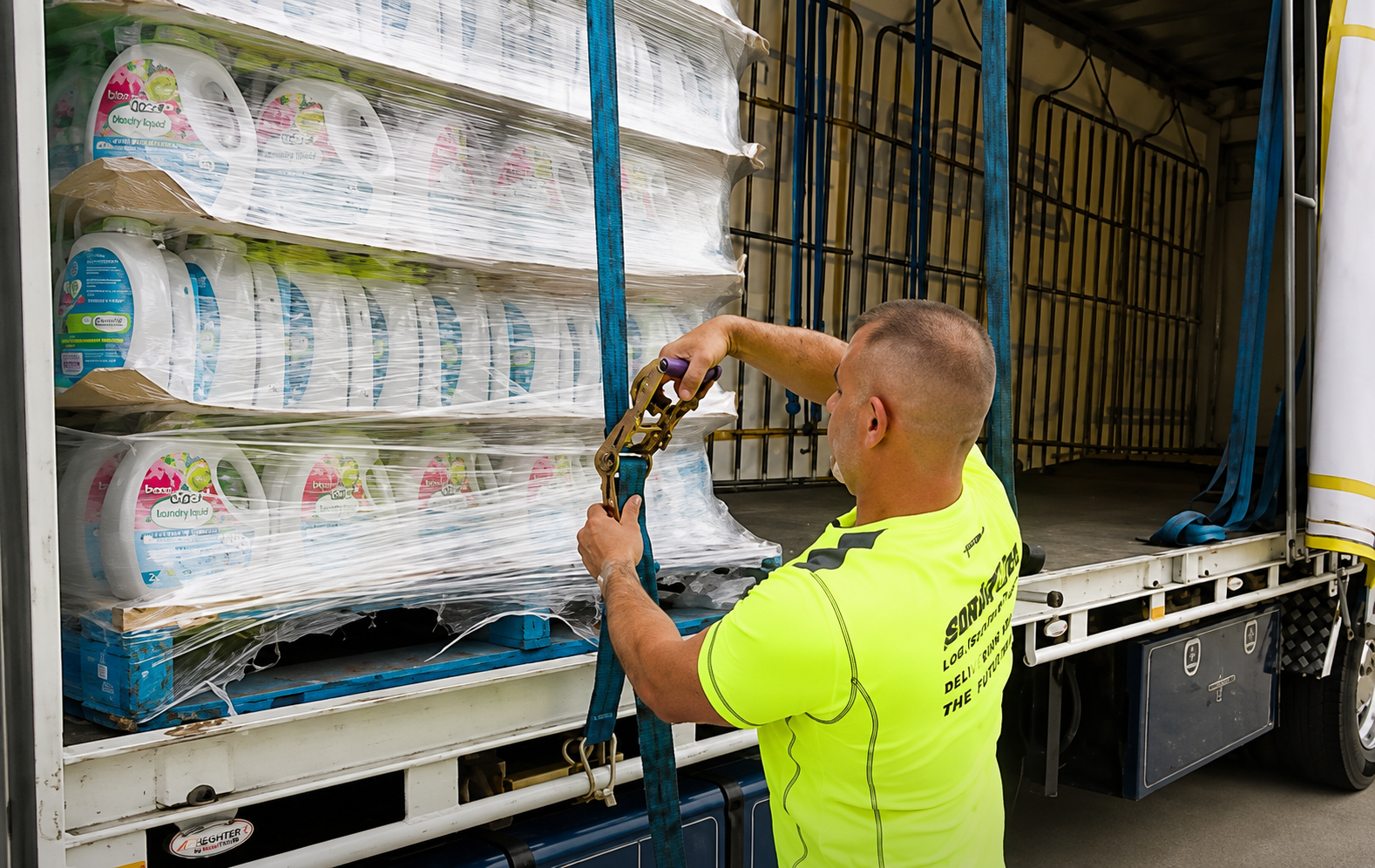
The delay usually starts before the truck even leaves the yard. A driver is climbing in and out of the body, reaching for straps, shifting awkwardly around freight, and spending too long on a task that has to be repeated stop after stop. If you are looking at how to secure freight faster, the real issue is not just speed. It is whether your restraint method is built for safe, repeatable loading under everyday transport conditions.
For tautliners and curtain-sided trucks, freight restraint has to do two jobs at once. It has to keep the load safe and compliant in transit, and it has to fit into the pace of commercial freight operations. When the restraint process is slow, labour-heavy, or physically demanding, the cost shows up in driver fatigue, loading delays, and avoidable risk.
How to secure freight faster without cutting corners
There is a simple mistake many operators make when they try to improve loading times. They focus on driver effort rather than system design. A good driver can work efficiently, but no driver can make an outdated restraint method fast, safe, and consistent every day.
Securing freight faster comes down to reducing unnecessary handling. If the process requires repeated climbing, stretching, lifting, or repositioning to apply restraints, it will always be slower than it needs to be. It will also expose drivers to more manual handling strain and more time working around open traffic areas, loading docks, and uneven ground.
A faster restraint process is usually a more controlled one. When the restraint point is easy to access, the hardware is fitted to suit the truck body, and the system can be applied from ground level or with minimal reaching, the time savings are immediate. More importantly, those savings are repeatable across different drivers, routes, and freight types.
The biggest causes of slow freight restraint
In most fleets, restraint delays are not caused by one major failure. They come from small inefficiencies repeated across every load. Traditional strap handling, poor access inside the truck body, misplaced restraint gear, and awkward manual movements all add minutes to each job.
That may not sound like much on a single delivery. Across a metropolitan run with multiple drops, or a regional fleet working tight schedules, those minutes become operational drag. They also create pressure. Once drivers are under time stress, the temptation to rush restraint tasks becomes a safety problem.
Another common issue is inconsistency between vehicles. If one truck has a practical restraint setup and another relies on a slower, more labour-intensive method, the fleet cannot standardise loading time or driver expectations. Workshops, operations teams, and drivers all end up dealing with the variation.
Manual handling is often the real bottleneck
Many operators think the bottleneck is the strap itself. In practice, the real bottleneck is body movement. Every time a driver has to climb, overreach, drag equipment, or work in a cramped position, the task slows down.
This matters because freight restraint is repetitive. Even a modest reduction in physical effort per load can produce a significant gain over a week, a month, or a full operating year. It can also reduce the wear and tear that contributes to soft tissue strain and lost time incidents.
Access matters as much as restraint strength
A strong restraint system is only part of the answer. If it is difficult to deploy quickly, drivers will feel the impact before management sees it on a spreadsheet. The best setup is one that combines compliant restraint with straightforward access and minimal labour.
That is why the truck body itself matters. Curtain-sided trucks and tautliners need restraint solutions designed for the way freight is actually loaded and unloaded, not systems borrowed from a different application.
What a faster freight restraint process looks like
If you want to know how to secure freight faster in real operating conditions, look for a process with fewer touchpoints. The driver should not need to constantly retrieve loose gear, climb repeatedly into the body, or manually wrestle restraints into place.
A better process is one where restraint equipment is integrated into the vehicle setup, easy to reach, and quick to apply. That reduces handling time at the point of loading and makes the task less physically demanding at delivery points.
For many tautliner operators, that means moving away from loose, labour-heavy methods and towards a fitted restraint system designed specifically for curtain-sided applications. A patented internal load restraint approach can materially improve both loading speed and driver safety because it changes how the restraint is applied, not just what is being used.
Why system design changes the numbers
There is a commercial difference between working harder and working smarter. Faster freight restraint should not rely on drivers making up time through extra effort. It should come from a system that removes wasted movement and supports a more efficient workflow.
When a restraint solution is properly designed for tautliners, the gains usually show up in three areas. The first is loading speed. The second is reduced physical strain on drivers. The third is consistency across the fleet.
Consistency is often overlooked, but it matters. If each vehicle can be restrained using the same method, operations become easier to train, easier to supervise, and easier to scale. Procurement also becomes simpler because the business is investing in a standard approach rather than patching together different fixes.
Faster can also mean safer
There is sometimes a false assumption that speed and safety work against each other. In transport, that is not always true. A safer process is often faster because it removes the steps that create risk in the first place.
Less climbing means less exposure to slips and falls. Less awkward reaching means less strain. Less time spent handling loose equipment means fewer interruptions and less chance of error. If a system allows the job to be done with minimal labour while still keeping the load safe and secure, speed becomes a by-product of better design.
Choosing the right setup for tautliners and curtain-siders
Not every freight task is identical, so there is no one-size-fits-all answer. Freight type, load frequency, delivery profile, and truck body configuration all affect what will work best. A metro distribution fleet with frequent stops may value time savings differently from an interstate operator carrying larger static loads.
That said, the right restraint setup for most curtain-sided trucks shares the same core characteristics. It should be purpose-built for the vehicle type, compatible with common truck brands, durable enough for daily commercial use, and practical for drivers under real loading conditions.
It should also be easy to fit into your existing fleet and workshop environment. If installation is difficult, parts are hard to source, or the system requires ongoing workarounds, any productivity gain will be diluted over time.
This is where an Australian-made, patented restraint system has a practical edge. It is built for local operators, local conditions, and the realities of freight work across Australian fleets. For businesses that want a serious safety and productivity outcome, that matters more than marketing claims.
What to ask before you change your restraint method
Before investing in any new restraint approach, ask a few direct questions. How many manual movements does the driver need to make per load? How much climbing is involved? How easy is it to train new drivers on the method? Can the system be used consistently across multiple vehicle types in the fleet?
You should also ask whether the method improves productivity without shifting extra risk onto the driver. If the only way it saves time is by encouraging rushed behaviour, it is not an improvement. If it saves time because the process is simpler and safer, that is a stronger long-term result.
For truck body builders and workshop managers, installation pathway matters as well. A system that can be fitted through established body builders and stockists is easier to roll out at fleet level than a niche product with limited support.
A practical view of how to secure freight faster
For most operators, the answer to how to secure freight faster is not more pressure on the yard and not more effort from the driver. It is a restraint method that matches the vehicle, reduces manual handling, and makes safe loading quicker by design.
That is why purpose-built systems are gaining attention across Australian freight operations. When the restraint solution is engineered for tautliners and curtain-siders, drivers can secure loads with less physical strain and operators can move freight with better time control. StrapNGo is built around exactly that outcome – improving safety and productivity without adding complexity to the job.
If your current restraint process feels slower than it should be, that is usually a sign the system is asking too much of the driver. Fix the method, and the speed tends to follow.